Hostal de la Muga
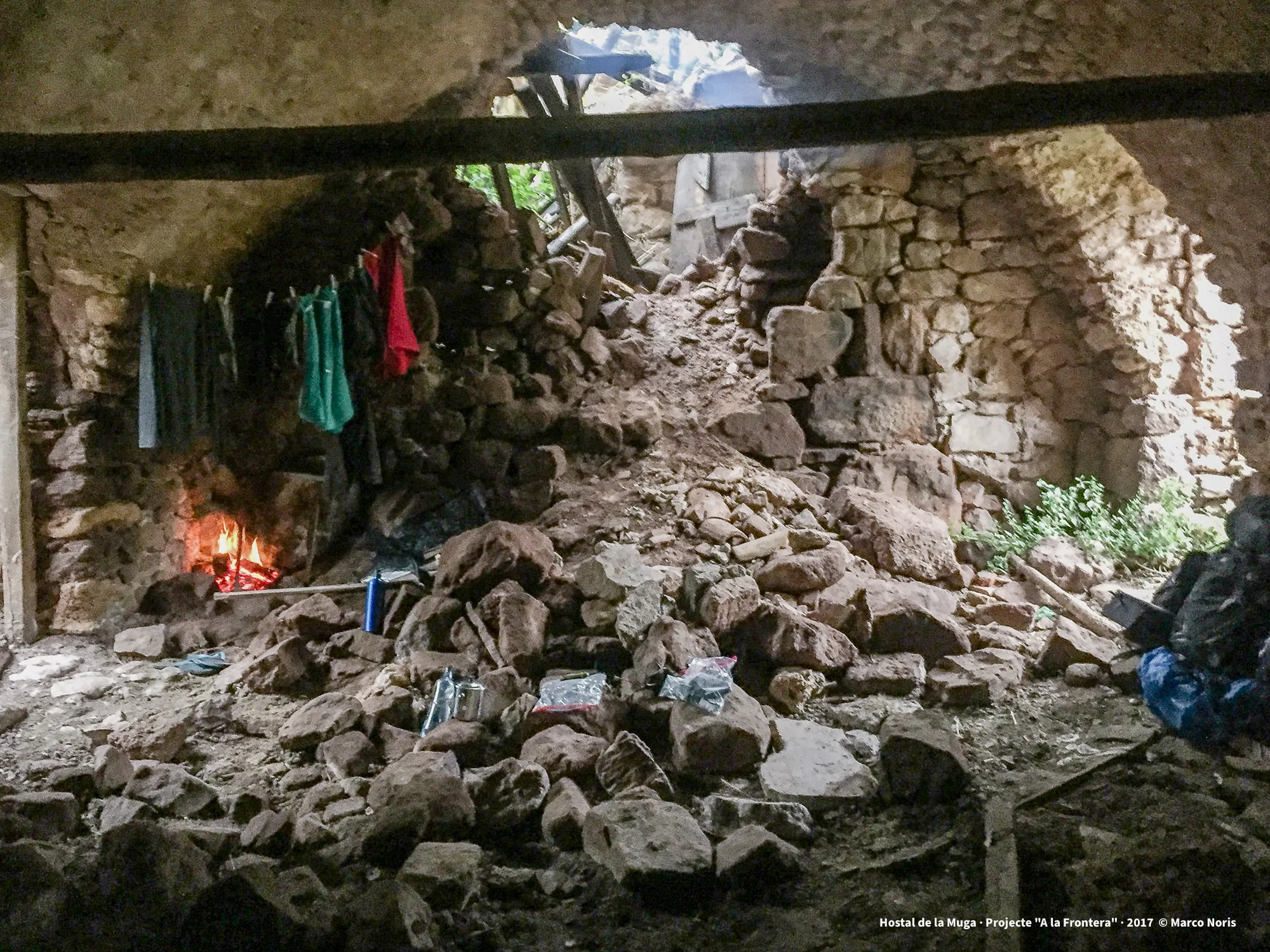
Hostal de la Muga during Marco Noris’s walk «On the Border», 2017
I reached Hostal de la Muga walking along the border line, with my painting gear on my back. «On the Border» (2017) is a journey on foot and in paint along the Pyrenean strip that separates —and at the same time stitches together— the Spanish and French states. Confronting the plein-air tradition, I recorded in situ the places marked by exile and resistance.
Refugees at the border
On 31 August 2017, during the «On the Border» walk, Amaranta Amati and I were caught by a storm as we descended a wooded slope in search of border markers 524/5281. It was a fold of mountain bounded by a couple of ravines, with no signal whatsoever, wrapped in a blanket of clouds dense and heavy with water. The storm was ferocious: it never seemed to end and so much water fell that it got into the very pockets of my raincoat. The path was steep and difficult, with no trails, cut by the ravines, which kept filling with water as the hours passed. Nothing was visible. It was one of those moments when you realise that, in the mountains, a moment’s carelessness is enough to turn everything into tragedy.
Luckily, Amaranta remembered having seen on the map a building about a kilometre further on, at the end of the slope, where the track resumed. We armed ourselves with patience and caution to get there without mishap.
That is how we reached Hostal de la Muga, a grim building in ruins, where we improvised a fire and a camp to spend the night. In that moment we were refugees at the border. Later I learned that the Hostal had been an important crossing point for travellers, smugglers, armed forces and maquis, especially during the incursions of the anti-Francoist guerrilla Quico Sabaté.
Border memory
Hostal de la Muga is an old farmhouse located in the municipality of Albanyà, in the Alta Garrotxa (Alt Empordà), at around 710 metres of altitude and a short distance from the border line with France. For a long time it worked as an inn and resting point on a mountain route: muleteers, smugglers, hunters and hikers stopped there, as did the pilgrims crossing towards the Vallespir. With depopulation and loss of use, the building gradually fell into disuse until it was left abandoned and in ruins at the end of the 20th century.
After the Civil War, that border crossing became a way in for the maquis. The anti-Francoist guerrilla Quico Sabaté used the Hostal de la Muga route in several incursions (1956, 1957) and in the last one, at the end of December 1959: from his base in the Vallespir he came down towards the Hostal and continued through Sant Julià de Ribelles, the coll de Principi, the coll de Bassegoda and Lliurona as far as Falgars. That incursion would end with his death near Sant Celoni on 5 January 1960.
Hostal de la Muga is currently in an advanced state of ruin and completely abandoned. The process of decay accelerated from the 1990s on, especially after the death of its last inhabitant, known as the Met de la Muga, in 1992. Eviction threats and lack of maintenance have contributed to the building’s progressive deterioration, which has gone from being an emblematic establishment to a ruined structure in little more than three decades.
- Hostal de la Muga — Wikipedia (ca)
- L’Hostal de la Muga — Colla Cansalada
- Francesc Sabaté Llopart — Wikipedia (ca)
- About the project: Dues mirades a la frontera (Diari de Girona, 2018)
- Full notes: Hostal de la Muga
-
In the project’s original language these border markers are called mugas. Muga (“boundary stone”) is a word of Basque origin used in the Catalan Pyrenees instead of mojón (or hito, in Spanish) and fita (in Catalan). Although it comes from Euskara, the term is also recorded by the Royal Spanish Academy and is used in Spanish with the same meaning: “boundary or border between territories.” ⤶