The nomad who painted the border
The original article by Eliseu T. Climent was published in El Temps on 16 July 2024. The copy on this website is my personal archive.
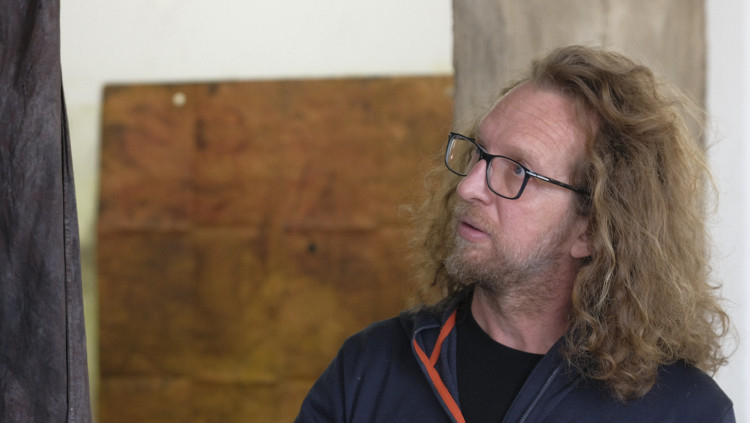
He had never walked in the mountains before, but the desire to experience the border in his own skin led Marco Noris (Bergamo, 1971), settled in Barcelona for two decades, to an artistic-hiking exploration that would extend across the border comarques of Girona, from the Andorran limits to Portbou. Out of the more than 300 kilometres walked, carrying his painting tools —besides the personal gear needed to make this crossing—, On the Border (2017) was born, an ambitious project with more than 200 paintings.
What did that crossing along the border line produce?
In 2017 I presented the project On the Border and five years later, although I had gathered the material during that walk, I mapped its toponymy. But this process is not closed for me, because I would like to keep covering other border areas, such as the central Pyrenees.
Why did you choose the eastern Pyrenees, the Girona border?
Because it was in this sector that most of the exile routes were concentrated. At that time this subject motivated me, because I was working on a project about the Rivesaltes camp, which gathered the Spanish exiles during the Spanish Civil War. It was also a moment when I was recovering my relationship with art: I came from abstract painting and felt I needed to break out of mechanical repetition and explore new languages.
I approached exile out of personal motivations and a deep individual feeling, far from the coldness of a theoretical approach. Alongside the project on Rivesaltes, I was working around the concept of refuge, in the broad sense of the term. It was a moment when the problems of the migratory waves towards Europe across the Mediterranean, and the European policies in this area, had erupted.
I began to introduce the present into my painting, through small details. For example, I have an oil inspired by a photograph of the Rivesaltes camp where a queue of people is waiting for food. To one man in that queue I painted an Adidas trainer. It is a look towards the past, but with that detail that points to its future, our present. In my work the notion of time always appears, the play between past and present.
In the case of the border, I did not want to go to a series of points and paint from there either, but to live it and understand this place as a space where things happen. This coincided with a personal moment when I was working on the notion of landscape. I did not want it to be a fleeting experience, but to have a real involvement with the border landscape. I wanted to be landscape and not attend it as a spectator.
Nor was it about doing a work on exile in general terms, which could have been, for example, on the Greek border with Turkey. I wanted to know the nearby border, that of the Pyrenees, the history of here, of Catalonia, where I live. Walking was the opportunity to immerse myself in the territory and not only in exile.
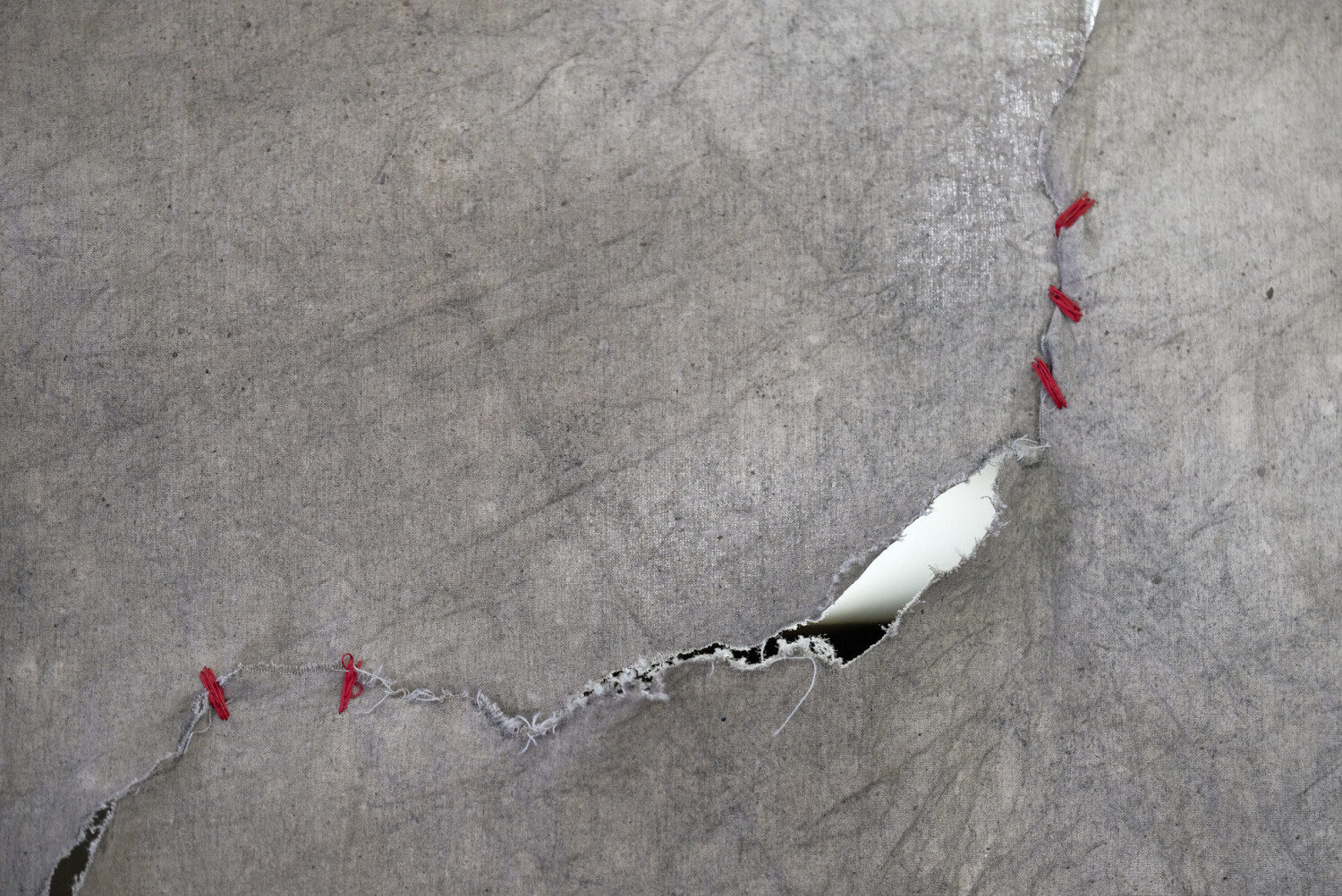
The border, a permeable space / Eliseu T. Climent
How did you plan the walk?
To begin with, I chose the stretch of border I wanted to cover which, as I said before, corresponded to that of the comarques of Girona. As for the direction of the walk, I saw it was more coherent to start in the mountains, at the border with Andorra, and end at the sea. As a human experience.
It seems the last border muga, number 602, is in the Foradada cave in Portbou, with access from the sea.
Indeed, I did a stretch by boat and reached it swimming, dragging the painting material on an inflatable mattress. I went into the cave, painted the muga and left. Bathing brought me close to a purification ritual. It was the end of the pilgrimage.
Tell me about the logistical preparation of the crossing.
For me, everything was new. I had never walked in the mountains. So I asked a friend, Amaranta Amati, who is a mountain guide, for help. She accompanied me for almost the whole journey, except the last week, and helped me to schedule and plan the stages, the choice of material and clothing, and above all, how to organise everything to do with the painting. Since I wanted to paint in oil, which needs between two and three days to dry, the working methods had to be carefully planned, along with the making of stackable, 3D-printed frames that kept the paintings from touching each other and let them dry as we went. All of it amounted to a significant logistical engineering.
It is not easy to walk carrying everything…
I carried it all on me, but I arranged three points where they came to bring me more material and I left the finished paintings. For example, before doing the Olla de Núria, I met some friends who also brought me food and water for the three days I had to spend in the high mountains.
I carried my personal gear, the cooking equipment and the tent; the painting tools —palette, colours and a box with the frames I mentioned—. The backpack, obviously, was not light. When I finished the Olla de Núria, I had more than 100 paintings done, which I left at a campsite for a friend to pick up.
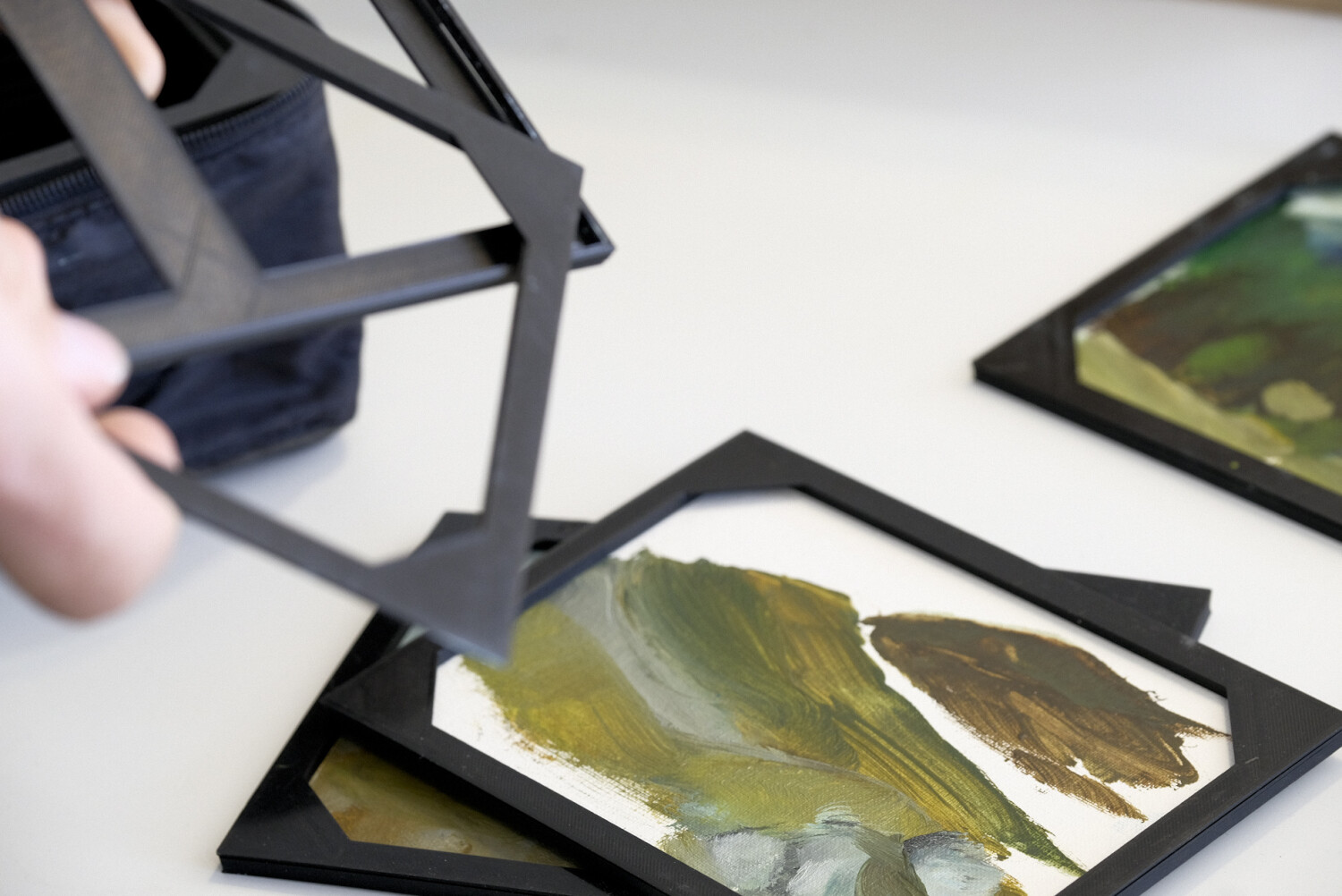
Paintings made along the walk / Eliseu T. Climent
Had you planned the places where you would paint?
Yes. The idea was to stop at each muga and paint from that point. Sometimes I arrived at dusk or at night; also in the rain, and despite those conditions I made the effort to paint.
There were days when I came across twenty mugas in 10 kilometres and others where they were much farther apart. I did not paint the mugas, but the landscape I was seeing. It was a way of showing, through a traditional language such as landscape painting and pleinairism, that the border is an administrative limit foreign to the landscape.
How much time did you spend on each painting?
Between getting out the material, looking and starting to paint, despite the tiredness, an average of a quarter of an hour. Now I look at some of the paintings and find them very weak, but the general state and the urgency of the moment influenced the creative process.
To paint at every muga, first you have to find them.
I painted at practically all of them. On the other hand, I did not find one, because it was at the bottom of a ravine, very difficult to reach.
Besides, we kept such a tight schedule that it prevented us from spending more time than we should looking for the most hidden mugas. I saw then that between planning and reality there were moments hard to reconcile, even regarding the pictorial techniques: in some cases I began painting in oil and ended up drawing, and other times, the other way round.
Even in the rain, I would stop and use rainwater and non-permanent marker ink to create a watercolour effect. One day I hurt myself in a fall and painted with blood.
I must say that this project imposed another way of working on me, facing the mountain and conditions over which you have no power of decision. You have to trust the chaos and that everything will turn out well.
There is prior geographical and historical documentation work related, for example, to the exile crossings, which is in part what you were after.
Yes, but it was not exhaustive research; rather, I left part of that work for the return and in relation to the places I was discovering. In fact, one spot was no more important to me than another, although the most used exile crossings appeared to me as significant places. Any place could be a possible border crossing.
A singular case was the night a storm caught us and we sheltered in a ruined building. We made a fire there and hung up our clothes to dry. Once home, consulting the map, I discovered it was the hostal de la Muga, where Quico Sabaté crossed the border for the last time.
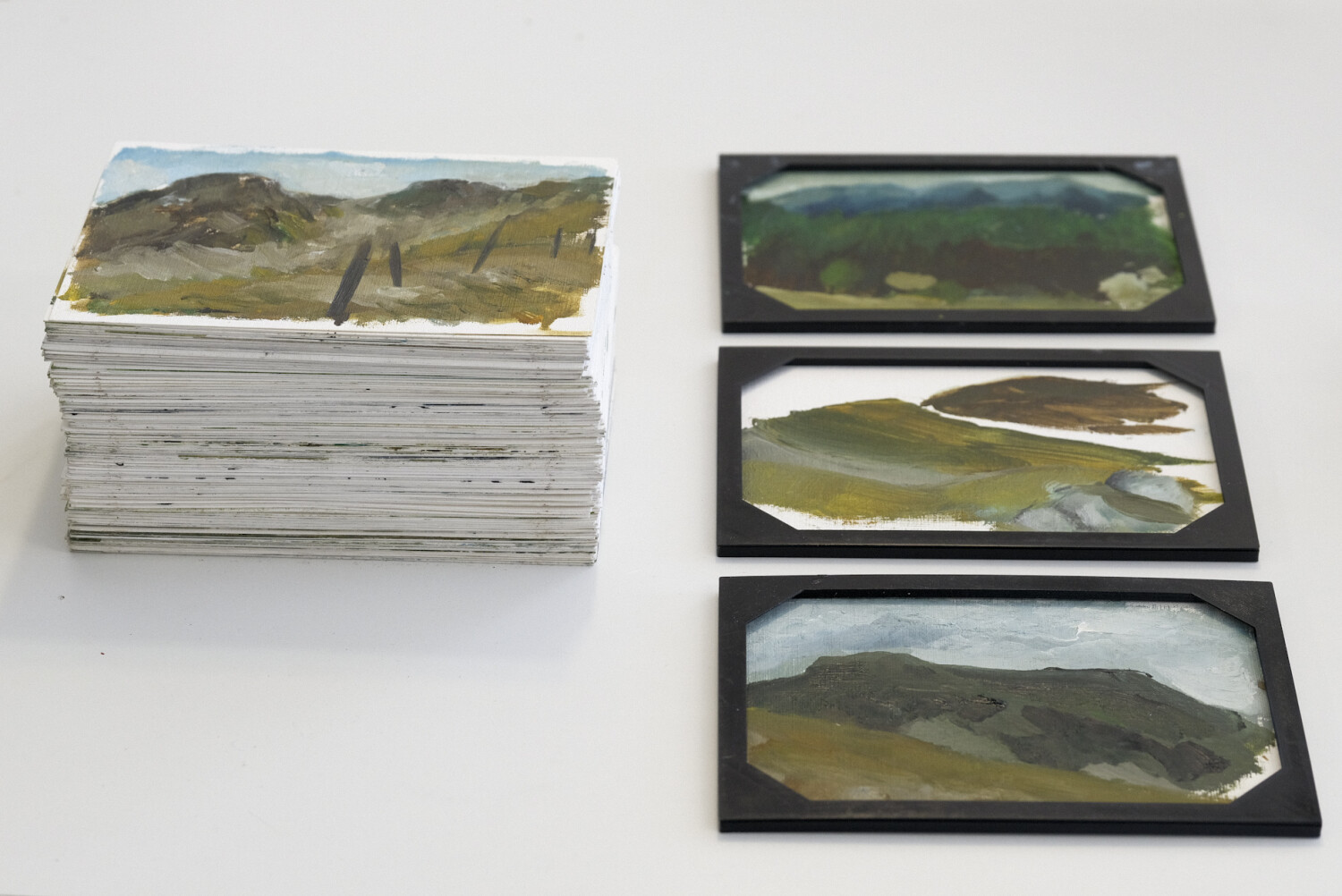
Paintings and gear loaded in the backpack / Eliseu T. Climent
What did you feel living the border as a geographical space with an entity of its own, as an interlude between two states?
It was a very intense experience of inner fullness, surrounded by a most beautiful nature. I did not feel the border until the more civilised areas, such as Puigcerdà or El Pertús.
In the mountains, you would come across the fence of a private property sooner than one separating the two states. In the natural space, the border is generally imperceptible.
Your second project related to the border is a toponymic map you presented in 2022, with the information gathered during the 2017 crossing. Toponymy is building the territory in words, referring to its mythology and stories, its colours and forms. Did you compile the place names from conversations with local people, or based on official cartography?
Good question. I did it with cartographic sources. I would have liked to get the inhabitants’ version, but I found it hard to come across people in the mountains.
Toponymy is complex and fascinating. In the project Sequere (2022) I even used people’s names as place names, because people are territory.
What did Sequere take shape as?
As a painting installation occupying 33 metres of wall, which is an artistic way of walking the 750 kilometres I covered. Besides, the list of place names also invites you to walk the path again: the 4,300 names I present occupy 4.5 metres of work.
How did you conceive the project?
When the Institut d’Estudis Ilerdencs (IEI) proposed I do an exhibition about walking, I had the idea of taking the water from a river’s mouth and returning it to its source. Quite a symbolic gesture. From the IEI they proposed the Segre, being the river that passes through Lleida, but I did not find it meaningful for its end to be mixing with another river that continued towards the sea. So I framed the project from the mouth of the Ebro, because both rivers say a great deal about the territory: you cannot speak of the Segre without speaking of the Ebro, and vice versa. In this experience, I confirmed the essence of the river as a border, as an open wound in the territory, but also as a link.
The territory, an artistic approach / Eliseu T. Climent
Walking has become for you a means of personal and territorial exploration.
Walking is becoming a nomad, tying the territory together, from the rice fields of the Ebro to the Alt Urgell and the Cerdanya. Walking provides close contact and a direct reading of the geography, which lets you relate everything in a single simultaneous discourse. Walking is, too, a form of resistance.
Walking is a form of resistance, even against today’s hyper-acceleration.
Also a way of opposing journeys that go from one point to another, ignoring the route and the transitions. This is the basis for an artistic project I have pending about looking at the territory from the satellite: today we look at the territory more through the satellite’s eye than through the body’s experience. We have never looked at the territory as much as now, but from afar, or from very close, yet always virtually.
Walking is the basic, primary unit of existence in transit.
Do you declare yourself definitively a nomad?
Nomad is a way of conceiving existence. I have been living in Barcelona for twenty years, outside Italy. Painting is, too, a form of nomadism, as is intellectual nomadism, the kind that feels the need to explore.
Yes, I declare myself a nomad, as a life attitude.