Dues mirades a la frontera
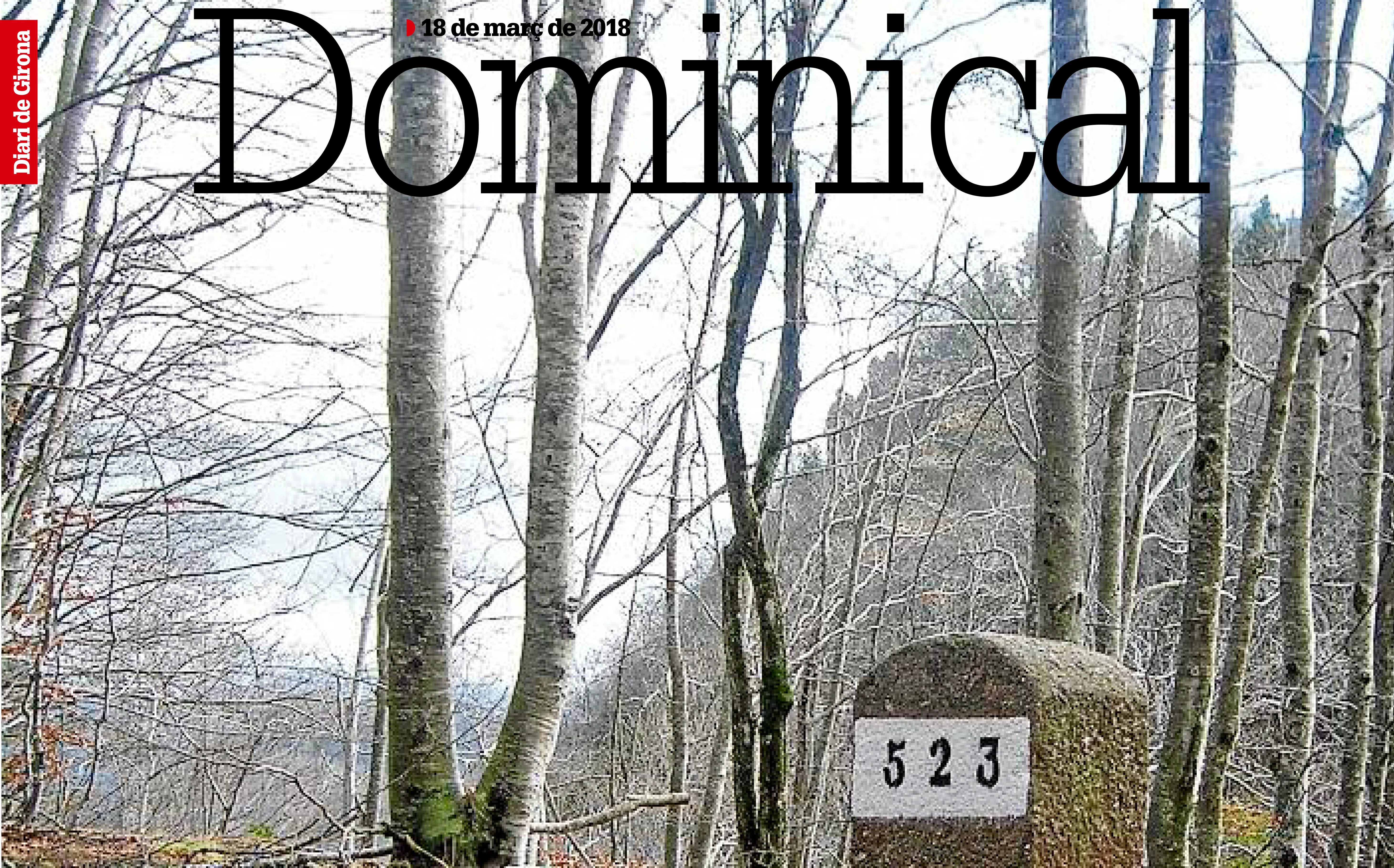
The original article by Matías Crowder was published in the Dominical (Sunday supplement) of the Diari de Girona on 18 March 2018: Dues mirades a la frontera. The copy on this website is my personal archive.
Cayetano Martínez has photographed and documented every border marker along the Spain–France border in the comarques of Girona; Marco Noris has turned these marks into the raw material of his art project.
Guided by the thirst for knowledge or driven by the desire to express, through art, the fusion of history and landscape, parallel paths lead Marco Noris and Cayetano Martínez to walk the border markers of one and the same border, that of the Pyrenees. Boundary marks that run across its peaks, sink into its forests and stand even in the most lost and inexorable cave.
Tracking down the mugas is no easy task. For the protagonists of this feature, it will be a struggle against the adverse conditions of a unique landscape, the Girona Pyrenees, and an inner path that will change them as people. A contest that plunges them into a true adventure on its trail.
Beside old bunkers, in the middle of border villages or buried under the weeds, the stone of the border markers, over the passing of the decades, bears witness to battles, to the passage of the Republican troops fleeing Francoism, to the history of the exile of thousands of refugees. The border soon turns immaterial, laden with legends that perpetuate themselves over time. Marco Noris and Cayetano Martínez will walk the paths joining mugas and reformulating the reality of the border.
Art at the border
The experience will be intense, physically hard. A harshness that would begin, for the Italian artist based in Barcelona Marco Noris (Bergamo, 1971), in the very organisation of the project. It is not only a matter of planning a mountain crossing (from Andorra to Portbou, in his case), with its supply problems; it is also a matter of making possible the creation of 200 small oil paintings —a technique that needs days to dry— and doing so following guidelines that cannot be controlled, such as where and when to paint them. Solving transport and support, reducing weight and volume, keeping outside intervention to a minimum so that the experience would not lose its meaning, will be essential for the start of the adventure.
The idea guiding Noris is the continuation of a body of work on the theme of historical memory, exile and migration, in which he already used the landscape as stage and as border, as a place of passage between physical and emotional reality. At once a tribute to the immigrants who crossed and keep crossing borders in search of a better life or out of the sheer need to survive. Nearly 300 kilometres of border make for a full pilgrimage from the heights down to the sea, in which the artist becomes a tabula rasa.
Once at the border, the working pace is so intense that Marco Noris needs to combine painting with drawing in order to keep to the schedule he has set himself. The route is programmed in detail by logistical conditions. He is accompanied by Amaranta Amati, a mountain guide who helps him plan the itinerary, organising the schedule and the food. They eat little, what they can carry with them: nuts, pasta and dehydrated rice. They sleep in the open wherever they arrive before nightfall; they also stay a few days at a campsite in Puigcerdà, spend a few nights in guesthouses in el Pertús and Portbou and four nights in mountain refuges.
They follow the border line, often along small paths or off them; they meet very few people. Only the animal species keep them company: mouflons, marmots, foxes, roe deer, wild boar, goats, sheep, cows… The crossing lets them traverse a great variety of terrain, cross small paths, forest tracks and steep coastlines. They cross fields, climb high mountains and walk through many woods: beech groves, pine woods, scrubland, oak groves.
The border they move through is steeped in history. That of hundreds of thousands of people fleeing fascist barbarity, like the suffering in the concentration camps of Argelers and Ribesaltes. The legless girl of the monument at la Vajol, the Roman history in its remains at el Pertús and Costoja. The dramatic end of Walter Benjamin in Portbou and the traces of pagan rituals and fables in the Alt Empordà. The antifascist songs of the survivors of the Mixed Brigade No. 143 at Bourg-Madame, the Francoist ambush of some maquis at the Pla de Collants. The story of Quico Sabaté and his route through the Hostal de la Muga. The old trades, the disappearance of rural culture and the rise of winter tourism, the transformation of smuggling into the trade in alcohol, tobacco and sex at el Pertús…
«I could go on parading lives; there are many layers of history at the border. Walking it has been, in a way, like moving through a film, a journey in time peeling back layer after layer», the artist states. «At borders the dramas and contradictions of our world become visible, as do the hypocrisy and pettiness of political and economic powers. But looking at it from another point of view, and thinking of the Pyrenees, mountain passes have also served as a way through for people, livestock and goods; the border has always been a place of meeting, exchange and sharing. If we wished it, the border could be mixing rather than exclusion».
Refugees in the storm
On the fourteenth day of the crossing, descending from the Pla de les Maçanes through a forest off the trail, they are caught by the storm. Soaked through, among brambles and weeds, they manage to find shelter in the ruins of the Hostal de la Muga, a grim building that exudes history from every stone. There, among the rubble, they hang out their clothes and improvise a fire.
«All of a sudden, for a few hours, we became refugees, in the purest sense; with no phone or GPS, completely isolated, reality forced us to enact what we were paying tribute to. That day we crossed the border between the wild and the civilised. Parallel worlds a few kilometres apart that never come to touch. Despite everything human beings do to try to protect themselves, the wild remains very close; we carry it inside».
The experience also amounts to a real master class in mountaineering for Noris, who leaves Barcelona without even knowing how to put on his backpack and arrives on the last day leading a small group through the storm. The cows, always so still and calm, prove a great example in the hardest moments. «Be a cow», the artist tells himself. «If they can, why can’t you?». Almost at the end of the route, Noris finds a cow’s tooth that strikes him as a great prize of learning. From then on he will keep it on his study desk so as not to forget: «Be a cow, Marco, be a cow».
«It was a process of letting go, renunciation and transformation. I left Barcelona on the day of the attack (17 August 2017), with a great deal of stress and pain; I shed my identity on the ridges of Núria, I became mountain and border, I turned into the terrain I was treading and I reached the sea in silence». The journey becomes an inner path. «There are many borders, one for each place and one for each person who crosses it; the concept of border is as broad as each of them; I cannot change a thing by changing, but I was able to enrich my idea of it, to give it one more face, my own».
Having reached the end of the route, the most difficult of the mugas still remains to be portrayed: the one in the cova Foradada. Noris decides to make the journey by boat, the only means of access. There, without hesitation, he throws himself into the water and enters swimming, carrying the painting materials on a swimming board. Once in the cave, on a rock, shivering in the cold tramontana wind, he paints the last muga of the journey.
The journey, made in the summer of 2017, bore its fruit: a total of 212 works, of which 82 are oils, 9 mixed media and 121 drawings. They have already been exhibited at the Museu Memorial de l’Exili (Mume) in la Jonquera and continue today their itinerary through shows and exhibitions. Marco Noris is preparing a publication produced by La Capella, Institut de Cultura de Barcelona, to be presented in April together with the pieces made along the way.
Drawn to the border
For Cayetano Martínez (Girona, 1969) it all began in the summer of 2013, when he was on the beach reading a book about the town of Portbou. Among its pages, his curiosity was sparked by a photograph of an enigmatic number beneath a cross, engraved on a large mountain stone beneath which he happened to be sitting at that very moment. They turned out to be marks forming part of the demarcation of the Spanish–French border, from the Mediterranean Sea to the Cantabrian Sea, under the Treaty of the Pyrenees of 1659.
In those days, Martínez made regular hikes along the border, so he decided to locate and photograph all the mugas that appeared in the book, corresponding to the municipality of Portbou, whose entire coast he already knew, but not its mountains. What followed became almost an obsession: there was something about the border that drew him and that had to do, at the same time, with a personal search.
As he makes his way by walking, he discovers that the undertaking he has just begun will not be as pleasant as he imagines, since the Border is quite happy to abandon, every now and then, the path marked out by man, in order to follow its own. To locate all the border markers he was missing, it would not be enough to advance following the indications of the local routes. He would need to examine the cartography in detail, research on the network of networks, explore arduous trails in situ and, above all, walk for whole days, under adverse conditions such as extreme heat, the harsh cold of the Pyrenees in winter, or being battered by the tramontana, the gusts of hurricane wind that want nothing to do with seasons or borders.
Some border markers were, at that time, sheltered from outside eyes, hidden behind a thick layer of brambles and nettles, or buried under a blanket of fallen leaves, well into autumn. There were not a few days of defeat, when he came home without having found anything. But in the end the undertaking was not in vain.
When he had completed all the border markers within the municipal boundary of Portbou, he went on with those of Colera, then those of Rabós, and so on until completing the whole comarca of the Alt Empordà, and then continued towards the Garrotxa and the Ripollès, finishing with the entire Girona border in the comarca of the Cerdanya.
This fascination with borders, which began as a simple hike through the Albera, ended up becoming, according to Cayetano Martínez, his personal «Camino de Santiago». For each muga there was a path to walk, a photo that became much more than a trophy, an inner journey of reflection and knowledge. The next step was to pour the result of all the work he had carried out into a website, www.mojonesdelospirineos.com, which can still be visited today and which contains the photographs and location of each of the border markers recorded, along with other related information.
Impossible border markers
The hardest to reach is undoubtedly number 542, set in the bed of the Riu Major, in a place known as l’Era de les Mongetes, in Albanyà. The route to get there is very overgrown and easy to lose. «When I set out to locate it I had no GPS device of any kind, so I had to ask for the invaluable help of Serge Poncet and Jean Iglesias, two great experts on the mugas», says Martínez.
«There are several markers that were hard for me to locate, above all because at first I went with the map printed on paper and didn’t have the conveniences there are now for placing yourself at a geographic point. I remember, for example, number 596, at the Coll de Tarabaus (Portbou), which, with its white paint worn away, was very camouflaged with its surroundings. I had to go as many as three times to find it. Number 543, at the Collada d’en Proi (Albanyà), was also quite hard, as was number 481, being inside a private property and in a spot overrun by vegetation. Number 467/1 was particularly difficult to locate, being literally buried in a field of nettles, next to the Barcelona–Tor de Querol railway line, in Puigcerdà».
For Martínez it was a special moment to be able to see in person muga number 602, set inside the Cova Foradada, in Portbou. «I knew people who had reached it by sea; by land it is practically impossible, [you need] the help of a boat or paddling a canoe. I got as close as I could by land, and then I threw myself into the water and swam until I reached it. The surprise came when I took out my camera, which I was carrying well protected —or so I thought— and it was completely soaked, so I have no photo of this muga, for now…».
What is the point of placing a marker inside an inaccessible cave like the Foradada? Martínez explains it through the disagreement over deciding where the border would end on the Mediterranean side. In the end it was decided to place the last marker inside this cave with two entrances, so that one can enter, for example, from the Spanish side and come out on the French side, or vice versa.
As of today there are no «cheating» markers, the expert points out, since their position is perfectly controlled, by both the Spanish and the French authorities, through the most modern means of geolocation. «Another thing is that in the old days there might have been some shifting of markers, by night and by stealth, to gain a little more ground for one’s own use».
«What there are, are the exceptions in the Treaty of the Pyrenees. The border should run along the axis of the Pyrenees, but this is not so in some cases, such as the village of Costoja, the Sanctuary of the Mare de Déu de les Salines, the Fort of Bellaguarda… The clearest example of these exceptions is the Val d’Aran, which is Spanish despite being located on the northern face of the Pyrenees». Curious too are the mugas found in the middle of the village of Els Límits, which they split in two: the Els Límits neighbourhood, belonging to the municipality of la Jonquera, and the village of el Pertús form a single urban centre. You can, for example, park your car in French territory and get out of it in Spanish territory.
Some mugas are found in significant historical sites, such as the one at the Coll de Panissars, the junction between the Via Domitia, which crossed Gaul as far as Rome, and the Via Augusta, which crossed Hispania to far-off Cádiz (Gades). There stands one of the oldest mugas, a pyramid from 1764.
When Marco Noris set himself the project of portraying every marker, Cayetano Martínez proved an indispensable help in walking the route. No one knew the location of each one with such precision.
The path of the mugas, which began as a curiosity, became over time a whole personal experience. «If I have learned anything during this long journey, in which I have met great friends such as Serge, Eef, Jean, Charles, Josette, Alain-Pierre, Marc, Joan, it is that the border that once separated us now brings us closer», Cayetano Martínez added at the end of the interview.