Les muntanyes: els cims d’una vida
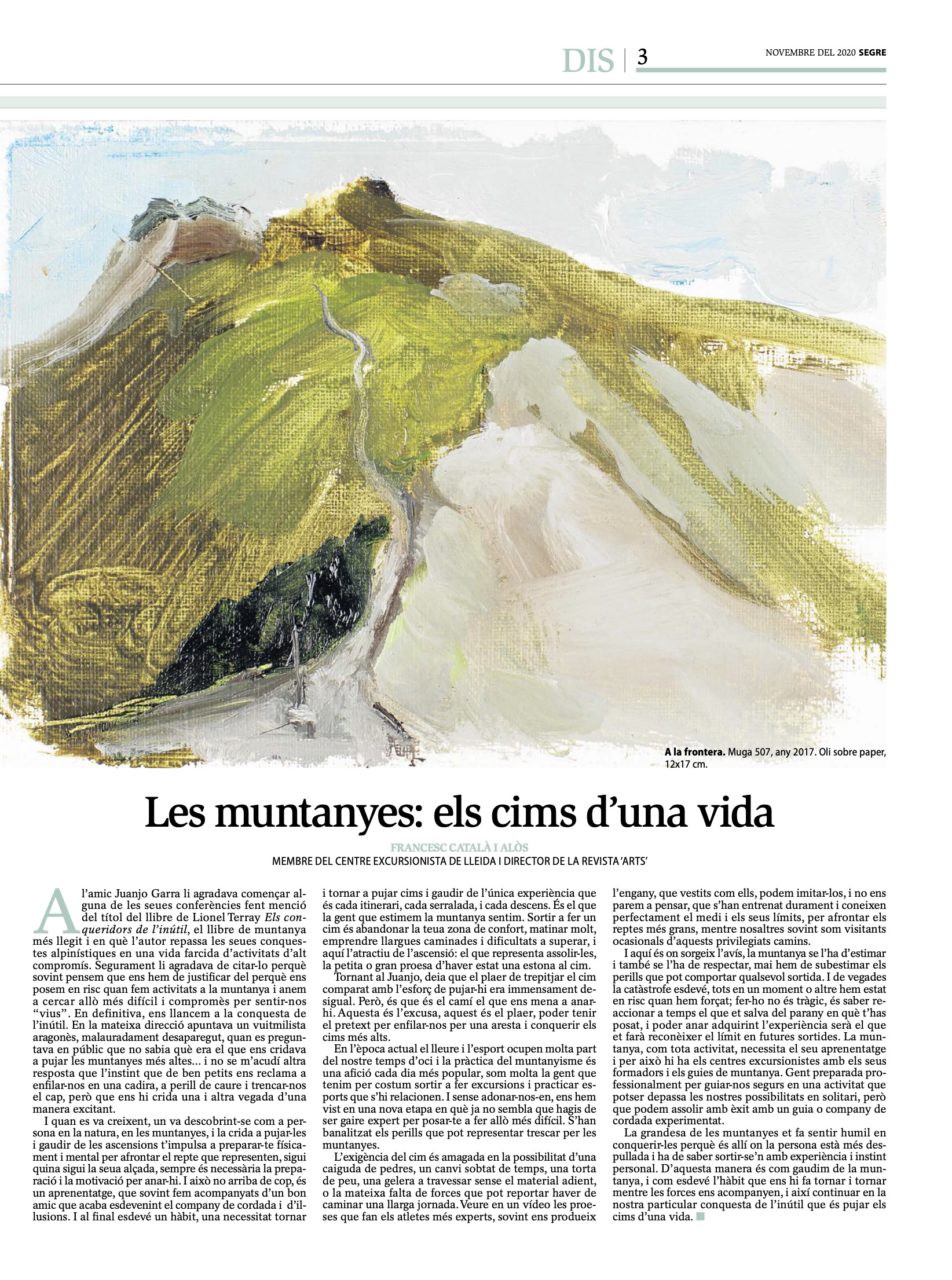
«A la frontera. Muga 507», 2017. Oil on paper, 12×17 cm.
Article by Francesc Català i Alós (member of the Centre Excursionista de Lleida and editor of the magazine Arts), published in Catalan in the DiS supplement of the Diari Segre in November 2020. It is illustrated with Marco Noris’s oil «A la frontera. Muga 507» (2017). The original text is also in the PDF. The copy on this website is my personal archive.
My friend Juanjo Garra liked to begin some of his talks by mentioning the title of Lionel Terray’s book Conquistadors of the Useless, the most widely read mountaineering book, in which the author reviews his alpine conquests in a life packed with high-commitment pursuits. He surely liked to quote it because we often think we have to justify why we put ourselves at risk when we take to the mountains and go in search of what is hardest and most demanding in order to feel “alive”. In short, we throw ourselves into the conquest of the useless. An Aragonese eight-thousander climber, sadly no longer with us, pointed in the same direction when he wondered aloud that he did not know what it was that called us to climb the highest mountains… and the only answer that came to me was the instinct that, from a very young age, urges us to clamber onto a chair, at the risk of falling and cracking our head open, yet calls us again and again in a thrilling way.
And as one grows up, one discovers oneself as a person in nature, in the mountains, and the call to climb them and enjoy the ascents drives you to prepare yourself physically and mentally to face the challenge they pose; whatever their height, preparation and motivation to go are always needed. And that does not come all at once: it is a learning process, one we often undertake alongside a good friend who ends up becoming a roping partner and a partner in dreams. And in the end it becomes a habit, a need to return again and again to climb summits and savour the unique experience that is each route, each range and each descent. It is what those of us who love the mountains feel. To set out for a summit is to leave your comfort zone, to rise very early, to undertake long walks and overcome difficulties — and there lies the appeal of the ascent: what it means to reach them, the small or great feat of having spent a while at the top. Back to Juanjo: he used to say that the pleasure of treading the summit, compared with the effort of climbing it, was immensely unequal. But it is the path that leads us to go. That is the excuse, that is the pleasure: to have the pretext to climb up a ridge and conquer the highest summits.
Nowadays leisure and sport take up much of our free time, and mountaineering is an increasingly popular pastime; many of us are in the habit of going out on excursions and practising related sports. And without realising it, we have found ourselves in a new era in which it no longer seems you need to be much of an expert to take on what is hardest. The dangers that scrambling through the mountains can involve have been trivialised.
The summit’s demand is hidden in the possibility of falling rocks, a sudden change in the weather, a twisted ankle, a glacier to cross without the right gear, or the very lack of strength that having to walk a long day can bring on. Watching on video the feats of the most expert athletes often deceives us into thinking that, dressed like them, we can imitate them, and we do not stop to consider that they have trained hard and know the terrain and their limits perfectly in order to take on the greatest challenges, while we are often only occasional visitors to these privileged paths.
And this is where the warning arises: the mountain must be loved and must also be respected; we must never underestimate the dangers any outing may entail. And sometimes catastrophe does come; all of us, at one moment or another, have been at risk when we pushed too hard — doing so is not tragic; what saves you from the trap you have got yourself into is knowing how to react in time, and gradually gaining experience is what will let you recognise the limit on future outings. The mountain, like any activity, requires its own learning, and that is why there are mountaineering clubs with their instructors and mountain guides — people professionally trained to lead us safely through an activity that may exceed our solo abilities, but which we can accomplish successfully with an experienced guide or roping partner.
The grandeur of the mountains makes you feel humble when you conquer them, because it is there that a person is at their most exposed and must know how to get through with experience and personal instinct. This is how we enjoy the mountains, and how the habit takes hold that makes us return again and again while our strength holds, and so carry on in our own particular conquest of the useless that is climbing the summits of a lifetime.
- Download the DiS supplement of the Segre (November 2020)
- Artist profile in the same issue: Marco Noris (profile, DiS)