Marco Noris, pintor de fronteres
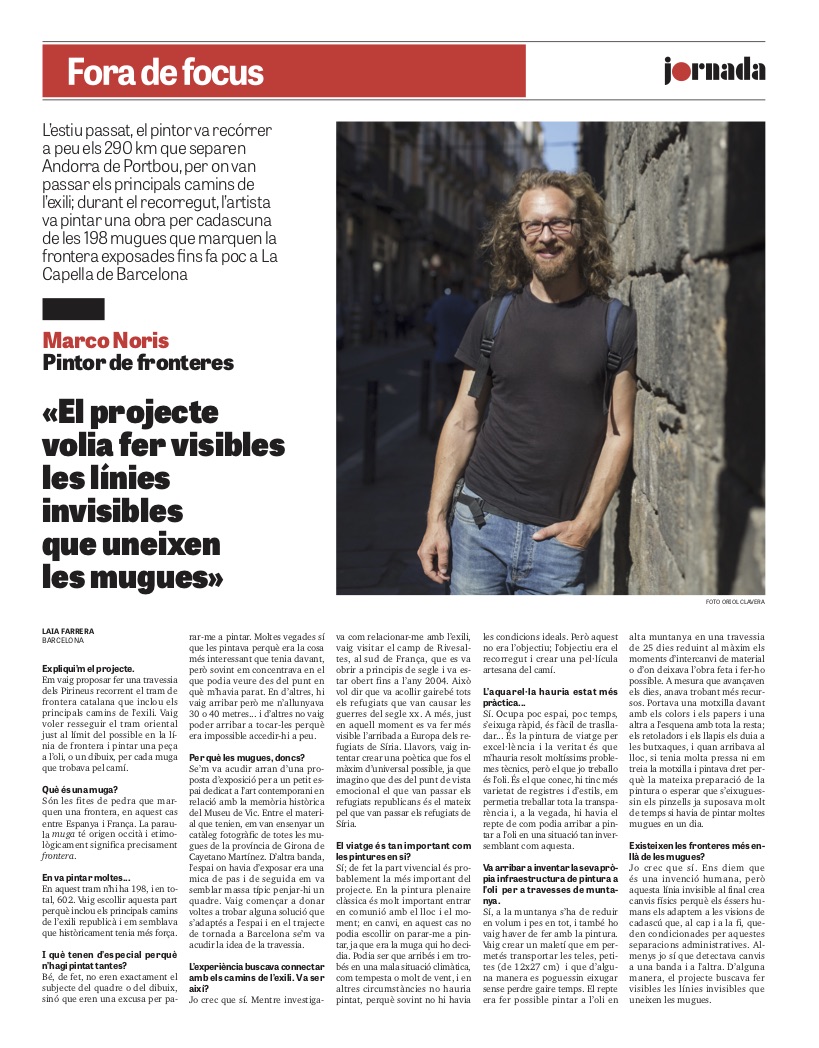
Interview by Laia Farrera published in Catalan in the Diari Jornada on 29 June 2018. Full (translated) transcription below; the original is also in the PDF. The copy on this website is my personal archive.
Last summer, the painter walked the 290 km that separate Andorra from Portbou, along which the main exile routes once ran; during the journey, the artist painted one work for each of the 198 border markers (mugas) that mark the border, shown until recently at La Capella in Barcelona.
«The project wanted to make visible the invisible lines that join the border markers»
Tell me about the project.
I set out to make a crossing of the Pyrenees, following the stretch of the Catalan border that includes the main exile routes. I wanted to retrace the eastern stretch right at the limit of what was possible along the border line and paint an oil piece, or a drawing, for each border marker I came across along the way.
What is a muga?
They are the stone markers that delimit a border, in this case between Spain and France. The word muga is of Occitan origin and etymologically means precisely “border”.
You painted many of them…
Along this stretch there are 198, and 602 in total. I chose this part because it includes the main routes of the Republican exile and it seemed to me that historically it carried more force.
And what is special about them that made you paint so many?
Well, in fact they weren’t exactly the subject of the painting or the drawing; they were an excuse to stop and paint. Often I did paint them because they were the most interesting thing in front of me, but frequently I concentrated on what I could see from the point where I had stopped. In others, I reached them but moved 30 or 40 metres away… and others I couldn’t even touch because it was impossible to reach them on foot.
Why the border markers, then?
It came to me from a proposal to exhibit in a small space devoted to contemporary art in relation to the historical memory of the Museum of Vic. Among the material they had, they showed me a photographic catalogue of all the border markers of the province of Girona by Cayetano Martínez. On the other hand, the space where I was to exhibit was a bit of a passageway and straight away it seemed too predictable to hang a painting there. I started turning over ideas to find a solution that would suit the space, and on the way back to Barcelona the idea of the crossing occurred to me.
The experience sought to connect with the exile routes. Was that the case?
I think so. While I was researching how to relate to exile, I visited the Rivesaltes camp, in southern France, which opened at the beginning of the century and stayed open until 2004. That means it took in almost all the refugees produced by the wars of the twentieth century. Moreover, just at that moment the arrival in Europe of refugees from Syria became more visible. So I tried to create a poetics that would be as universal as possible, since I imagine that, emotionally, what the Republican refugees went through is the same as what the Syrian refugees went through.
Is the journey as important as the paintings themselves?
Yes; in fact the lived part is probably the most important of the project. In classical plein-air painting it is very important to commune with the place and the moment; here, by contrast, I couldn’t choose where to stop and paint, because it was the border marker that decided. It could happen that I arrived and found bad weather, like a storm or strong wind, and in other circumstances I wouldn’t have painted, because often the ideal conditions weren’t there. But that wasn’t the aim; the aim was the journey and to create a handmade film of the path.
Watercolour would have been more practical…
Yes. It takes up little space, little time, dries quickly, is easy to carry… It is the travel medium par excellence and the truth is it would have solved a great many technical problems for me, but what I work in is oil. It’s what I know, I have a greater variety of registers and styles, it let me work all the transparency, and at the same time there was the challenge of how I could manage to paint in oil in a situation as improbable as this one.
You even invented your own oil-painting infrastructure for mountain crossings.
Yes, in the mountains you have to reduce everything in volume and weight, and I had to do that with the paint too. I created a case that would let me carry the canvases, small ones (12x17 cm), and that could somehow dry without wasting too much time. The challenge was to make it possible to paint in oil in high mountains over a 25-day crossing, minimising the moments of exchanging material or where I left the finished work, and to make it possible. As the days went by, I kept finding more resources. I carried one backpack in front with the colours and the papers and another on my back with everything else; the markers and pencils I kept in my pockets, and when I reached the spot, if I was in a great hurry I wouldn’t even take off the backpack and would paint standing up, because just preparing the paint or waiting for the brushes to dry already took a lot of time if I had to paint many border markers in a day.
Do borders exist beyond the border markers?
I think so. We tell ourselves it’s a human invention, but this invisible line ultimately creates physical changes, because we human beings adapt them to each person’s own ways of seeing, which, in the end, are conditioned by these administrative separations. At least I did detect changes on one side and the other. In some way, the project sought to make visible the invisible lines that join the border markers.
- Download the PDF: Diari Jornada, 29.06.2018