Body Ebro, the libidinal river
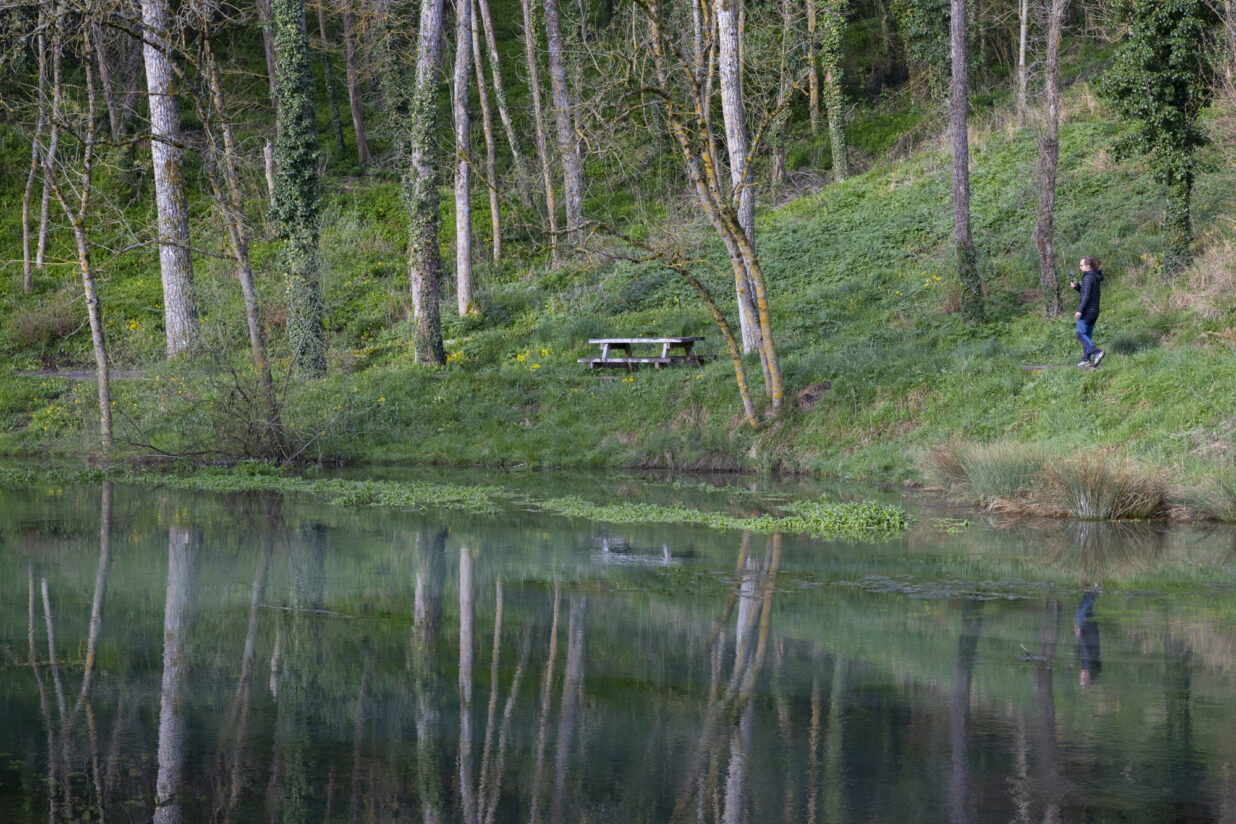
The original article by Anna Zaera was published in VilaWeb on 15 September 2025. The copy on this website is my personal archive.
The river still suffers the reservoir policy that intercepts it, preventing the sediments from reaching the end of its course, which threatens the survival of the delta.
This week marks twenty-five years since the birth of the Plataforma en Defensa de l’Ebre, the social movement that halted a great plan to divert water from the river. The Ebro mimicked a flood of human bodies, all in blue T-shirts, shouting “we are floods of hope”. Thousands of drops of water of all ages and conditions in defence of the river and the delta. This article is not a historical review of these twenty-five years —you can read that here—, but an attempt to think of the river as a living body, mistreated or plundered, which perhaps we will never fully come to know, despite our close coexistence.
We are now in 2025 and I am visiting the exhibition by the artist Marco Noris, made with the psychoanalyst Celeste Reyna at the Lo Pati Art Centre, which bears the name “Body Ebro”. Twenty-five years have passed and I feel like thinking about what this river that gives its name to my lands means to me. How I have lived it, how it has changed my body, or what its attributes of corporeality are. Whether it is matter or modifies matter as it passes. I have memories of direct contact, at the water’s edge, but above all I perceive it as a permanent and indirect presence. The painter Leonardo Escoda or the poet Zoraida Burgos used to say that the river had imprinted a character on them, just like the wind from above. That natural element that is always there, which we often observe from the distance of a bridge or from the car as we drive along it at the vehicle’s speed. With more flow or with less, muddy or silted. As my year-and-a-half-old daughter discovers it, who, whenever she sees it, shouts: “Swimming pool!”. What it would be like, river, if it were a body. We know it in its lower stretch, wide and serene, around Amposta or by Tortosa, like a little old man with a cane approaching the final judgement. Perhaps we have never seen it jovial and childlike, at its birth, in Cantabria, where it is virgin to everything and does not know what adventures and alliances destiny will offer it. Nor what lands or rubbish it will gather. Thanks to the title of the exhibition, I think of a body that carries cycles and stages.
Marco Noris, perhaps with the urge to know it well, set out to walk the entire course of the Ebro river in a crossing that in the end lasted eighty days. From May to July. From its birth at the springs of the Híjar, in the Peña Labra range, until reaching the Ebro delta. An artistic and bodily experience. Each step, a body. Each day and each night, a body. The artist told us that, although he came from the world of painting, in recent years walking had become a way of knowing the territory on a real scale and accepting it in its beauty or in its ugliness. In an age when there is no relationship with the territory through the body other than for sport or leisure, for someone to decide to look at the territory —and the river— up close and through a 1,200-kilometre route is unusual. We see, in a visual recording he has made in the form of a diary, the different stages of the river, the villages and landscapes it meets along its course. How the river crosses green mountains, rusted reservoirs, arid lands, industrial estates, places that have been left uninhabited or have become overpopulated. Even now I find it fascinating to learn that beyond the Baix Ebre, the Terres de l’Ebre or the Ribera d’Ebre there is a whole series of place names bearing its name that I have never heard. Kin of the river, said the singer-songwriter Montse Castellà as she travelled the waters from north to south by canoe.
The idea comes to mind that the river is a libidinal river. It awakens our desire for communion, for profanation, and also our extractivist will. In psychoanalysis, the libido is that drive that impels us to want to incorporate an object. The object of love. The fundamental energy of all expressions of pleasure and self-preservation. This dialogue runs in both directions. The river seems to act as a body and also infects and lets itself be infected by the same sensations a human body has. A sick body, a contaminated body, a body that receives, a body that only gives. In this exhibition Noris offers us his testimony of transference and countertransference. How his walker’s mood also experiences different emotions, almost following the river’s life stages. From the initial joviality, full of desire and expectation, to the apathy —or the diminishing of the libido— of crossing many kilometres through an arid and uniform landscape. How desire faded or resurfaced when changes appeared in the landscape or expectations of reward. How in the stretches with more extractivism —industries, estates and companies— walking became heavy and discouraging. The walker’s body revealing the river’s weariness.
The river has memory and knows that in the year 2000 Aznar had won the elections by an absolute majority. In 2001 the National Hydrological Plan was approved, designed by the then Minister of the Environment, Jaume Matas. The project consisted of transferring water from the Ebro towards Barcelona, the Valencian Country, Murcia and Almería. Those were peak moments for construction; there was talk of theme parks, of Terra Mítica, of golf courses, of a pharaonic Valencian Country that saw water as the main resource to keep the money-printing machine turning. The PP put out a message of joy: “Water for all.” The Ebro river glimpsed the highest point of fluvial extractivism. And it was at that moment that the people of the delta, guardians of one of Europe’s most fragile ecosystems, decided to organise themselves to put their bodies in defence of the river. Body and river, river and body, became an alliance that is now commemorated.
The river still suffers the reservoir policy that intercepts it, preventing the sediments from reaching the end of its course, which threatens the survival of the delta. One of the most repeated messages is that the struggle is not over. Water is once again at the centre of our concerns, all the more in a context of water scarcity. Noris inspires in us a desire for rediscovery that goes beyond exploitation. We want to look at it from up close, from a short distance that allows falling in love again. Such as observing the colour of its waters, the different soils and minerals it gathers. How its water serves to paint a watercolour, how little fish nibble the human skin of whoever dares to submerge their legs in it.
This very act of celebration, these twenty-five years, mean signing once again the desire to defend it. To refound the libido and let the commitment pass to the coming generations. To remember those young activists who now have white hair. To commemorate the bodies that fight and the body of the Ebro. To think of the matter that will die and that which will survive.
Anna Zaera, 2025. Original article: Cos d’Ebre, el riu libidinal on VilaWeb.