Marco Noris: «Walking is the most powerful and ancient act of memory»
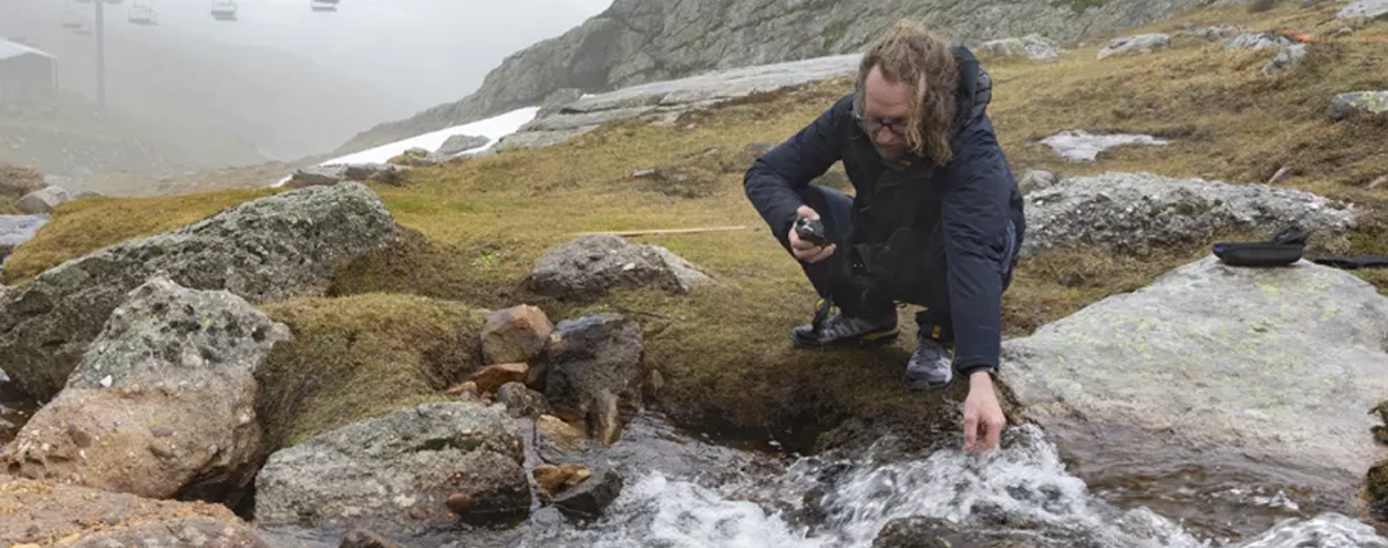
Marco Noris during his crossing. Photo: Oriol Gracià.
Judit Monclús’s original interview was published in Catalan in Surtdecasa on 3 September 2025. The copy on this site is my personal archive.
The Italian artist presents ‘Cos d’Ebre’ at Lo Pati, an exhibition that condenses the 1,200-kilometre crossing he made on foot between Fontibre and the Ebro Delta.
Eighty days of travelling on foot and more than 1,200 kilometres covered following the course of the Ebro between Fontibre and the Delta. This is the challenge the Italian visual artist Marco Noris (Bergamo, 1971) met in midsummer, and which has become the basis of an artistic research that conceives of the river as a living body, a political and cultural border, and an archive of memories and conflicts. Now, from 6 September to 2 November, Lo Pati hosts the final exhibition of the journey presenting the ‘Cos d’Ebre’ project, combining disciplines such as installation, drawing, video and writing.
Rivers, for me, are a metaphor for identity, whether individual or collective, since, in the end, we are all a set of tributaries.
— Walking as a way to get to know a territory, but also as an exercise in artistic creation. How does this combination work?
There is a great deal of literature on walking becoming an artistic tool or an aesthetic practice that, at the same time, has many layers of meaning. In my case, I defined walking as a research tool that allows you to know the territory first-hand, through experience and through the gaze. This is the basis on which I have structured my work, although each project is a little different from the previous one. In this case, in ‘Cos d’Ebre’, I have combined a record of the experience with the recording of audiovisuals, writing and watercolour, in which I used water from the river. In another project, I used instant photographs and oil paintings. I always try to maintain a level of plastic production. On other occasions, I have experimented with paper, with cloth, with water, with mud, with pigments, and other materials I picked up along the way. My artistic creations emerge during the journey. For example, in the specific case of this latest project, I recorded around eighty hours of video and many hours of audio, also using a hydrophone. Apart from that, as I was saying, I made watercolours, photographs, and so on. I didn’t stop working at any moment of the crossing. It was like having a nomadic studio. In fact, the act of walking itself I already see as an artistic act. If you think about it, in this era in which there is no relationship with the territory through the body other than running or cycling, the fact that someone decides to look at the territory through a 1,200-kilometre journey is already outside any contemporary logic. Now, however, the question is how to somehow achieve the transmission of this experience.
— In fact, this proposal, named ‘Cos d’Ebre’, fits into the line of work you have been developing for years around memory, place and displacement. Does that displacement enable memory or does it mean leaving it behind?
Walking is the most powerful and ancient act of memory we can exercise because it speaks of us, of what we are and where we come from. That is why, for me, walking is an act of memory because it explains the human being and where they come from, their nomadic era, and because, right now, with the depopulation of the territory, every footstep on an abandoned path is a way of remembering and of keeping active these paths that no one uses anymore: there are hardly any shepherds or farmers who walk the territory and keep the memory of the land alive.
— You spent 82 days walking from Fuente del Híjar to the Ebro Delta. What has this 1,200-kilometre route allowed you to learn beyond the landscape you have crossed?
Most of the comarques I walked together with Celeste Reyna, who was in charge of the theoretical construction of the project and accompanied me on this journey, were new to me. I had never been to La Rioja or Burgos before, for example. This, in itself, was already a new way of looking at the territory in general. Beyond the landscape, however, I learned many other things. On the one hand, and on a global level, the relationship of the territory and the administration with the river. It is curious how the Ebro is a geographical border and how the conflicts generated around it are located by comarques. Another very interesting thing was to see the extractivist relationship and the territorial distribution around the Ebro according to the geographical configuration. This has allowed me to see how people’s relationship with the river changes, for example. For me it was very important to be aware of the indirect self-knowledge of the humanity that now inhabits the territory.
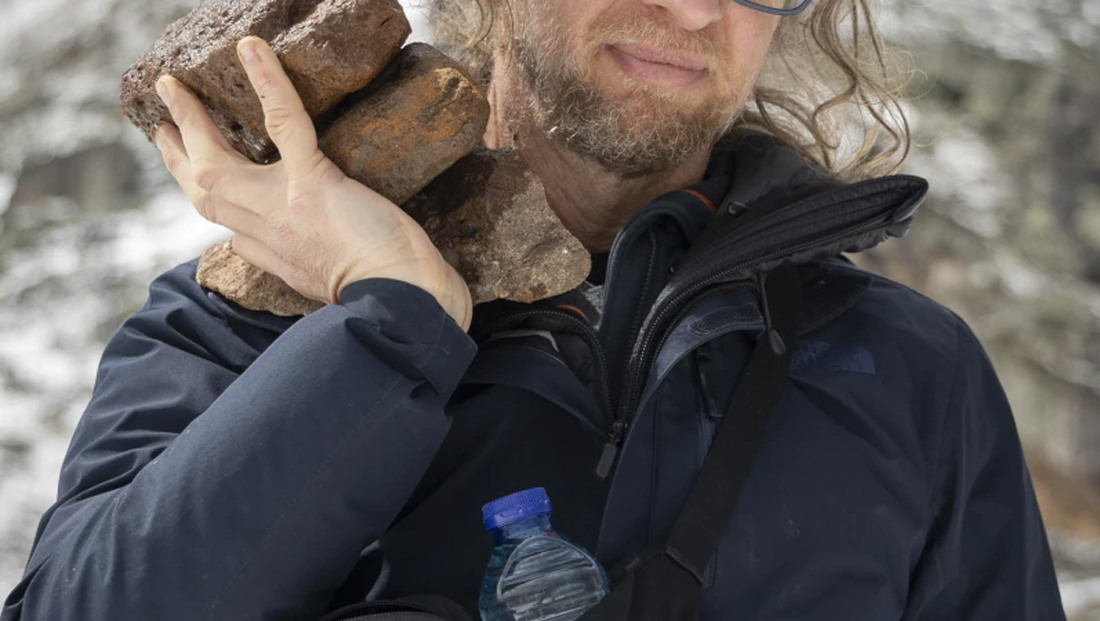
Marco Noris during the journey. Photo: Oriol Gracià.
— You collected drawings, texts, photographs, sounds, found objects and testimonies during your journey through the Ebro territory… Was there contact with the people of these lands, beyond the landscape?
Contact with people is theoretically a fundamental point, but it is very subordinate to the calendar and the territory. Part of the route we did in the middle of a heatwave. Sometimes you would arrive late at a village because you made more stops than planned or because you waited for the temperature to drop. We might arrive at seven in the evening after ten hours of walking and set out again the next day at seven in the morning. So contact with people was more limited than we would have liked. It could happen that days and days went by and the only person you spoke to for a moment was someone in a bar or a shop you went into to buy food. The territory is very empty and there are very few people. In any case, we gathered a series of testimonies that for me have become the beginning of an investigation, in the sense that they open doors to the reality of the territory but that, surely, the moment an investigation in this direction is activated, will need to be expanded and deepened. For example, in the case of a village in Cantabria, we found that it had only one inhabitant. We met him in the street and found that he had infinite availability to talk and tell us things. Or the case of Felipe, also in Cantabria, who told us his story as a worker in the Reinosa metallurgy. We also met people who did not want to talk to us, of course.
— You defined the ‘Cos d’Ebre’ project as an artistic research that conceives of the river not only as a natural element, but also as “a living body, a political and cultural border, and an archive of memories and conflicts”. Are the memories and conflicts you have deciphered in the territories along these 1,200 kilometres very different?
Some conflicts are very far from one another, but you can see their consequences, such as the stratification of ruins that allow you to see the stratification of time: Roman ruins, Romanesque hermitages, ruined farmhouses, wind turbines… You could have all these elements in short intervals along the route. It was almost like seeing the ruin of history in real time. As for the conflicts, you could see them in solar farms, in the wind turbines, in the water transfer and the defence of the river… This we can find from beginning to end. What impressed me most was seeing how contemporary development around the river has been a continuation, an echo, of the Roman conquest of the territory. In fact, the Roman road that passes through Zaragoza to the north shows that one bank of the river is better connected than the other, that it has developed more. It may be that the left bank is even more rural than the right one. I did not carry out a deep investigation, but it is the feeling I had looking at the territory from there. During the journey I had the sensation that the last two thousand years have only been a drift, a logical inertia, of what the Roman invasion was.
— So the “borders” you have been able to find have been more political than natural?
I think the first border is the geographical one and from there come the administrative or political borders. I always find it amusing to reflect on the etymology of the word “rival”. In Latin, it means one who shares the same stretch of water. We attribute to it the meaning of conflict between people, but its origin was that of sharing. In this case, however, the issue of rivalry related to the river is already integrated into language. Right now the conflicts are more about property and about the continuity of county borders, where everyone seeks an appropriation of the river according to their geographical location.
— You say that walking is a way of accepting the territory. What have you accepted in this crossing you have made?
Accepting the territory means that you are not necessarily walking through bucolic, beautiful and wild places. We came down from the Tres Mares peak, at 1,900 metres, until we reached the Ebro depression, which is at Miranda de Ebro. There, for us, a very important part of the journey ended, one that was wild and rugged, more depopulated and more natural. From there, we accepted that the industrial estates, the data centres like Amazon’s, the pollution of the river, the industrial and agricultural proliferation, was what reached us. Our body had to adapt to what we encountered along the way, whether having a hard time or redoing the route, accepting everything that came.
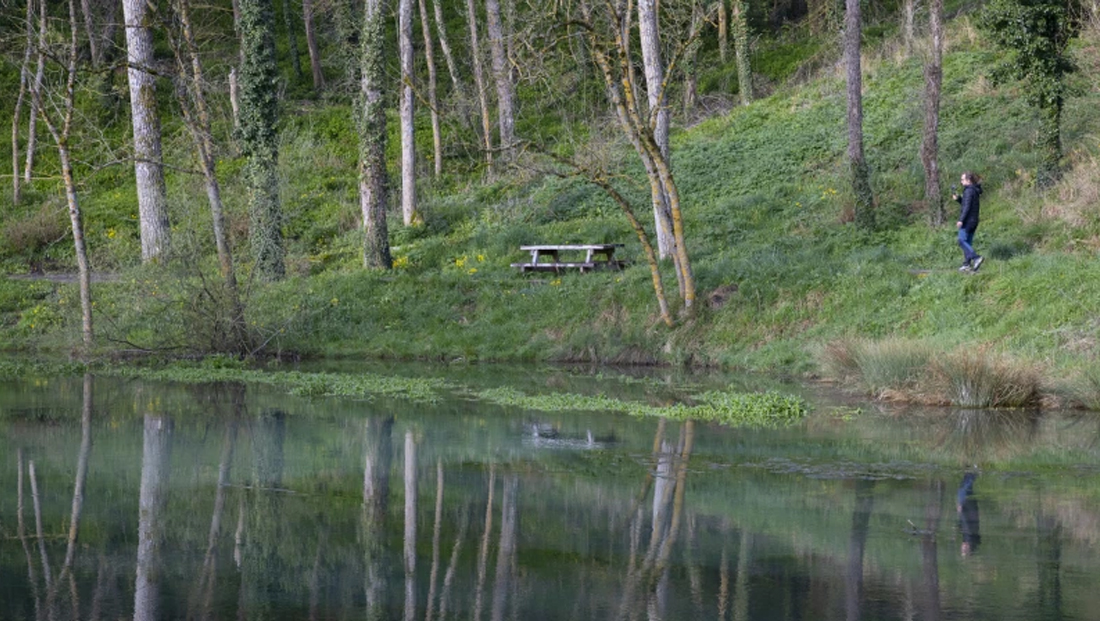
Marco Noris during the journey. Photo: Oriol Gracià.
— Did you encounter many problems or difficulties during the crossing?
It was all quiet, but there came a moment when the route turned into a constant change of calendar and itinerary, due mainly to the rain and to the harsh weather conditions. We also suffered from the lack of services and food, since rural depopulation affects the whole Ebro basin. We passed through a village that was the only one with a bar in that part of the route, with the bad luck that we did so on the day it was closed for its weekly rest. It seems trivial, but you wonder how it can be that in twenty-first-century Spain we have problems with the supply of basic services. We won’t die from it, but it is surprising, because we are always on the brink of disaster. Walking is now off the contemporary cultural radar. There are villages with small hostels, but only because they are located along the Camino de Santiago; otherwise, you don’t find any. In the end, the only thing accepted when you walk, the only accepted pilgrimage, is the franchise of the Camino de Santiago.
— A couple of years ago, you carried out the ‘Sequere’ project. You also walked, but that time to carry water from the Ebro to the Segre. What do rivers inspire in you, to take them as a reference when creating and walking?
Sequere is a Latin word —in Latin it means to follow, to flow; it is pronounced secuere and is one of the ancient toponyms of the river Segre— that led me to do that project you mention three years ago, although I held the exhibition two years ago. Rivers have a strong symbolic component in many respects: time, space, cyclicity… They also carry the theme of borders and of water as symbolic elements. They are elements that, since the human being appeared, have been part of the axes where life develops in nature and philosophy. I chose this name as a symbolic theme, but then I began a research on rivers, also in relation to tributaries. Rivers, for me, are a metaphor for identity, whether individual or collective, since, in the end, we are all a set of tributaries. Without the tributaries, the Ebro would be nothing. For me, that is a metaphor for identity. In the end, one always has a nationalist vision of a territory and always thinks from a monolithic and monocultural logic, but in reality a territory is rich precisely because of its cultural and historical tributaries.
— From 6 September to 2 November, Lo Pati will host the final exhibition of the journey, gathering all the material you have produced from the route. What will we find there?
We can consider this exhibition as a continuation of the crossing. I spent a month in Deltebre to finish producing it, and for me this has been more a beginning than a closure, a first step to start something new, since I finished the route last 11 July and now I’m opening the exhibition. Can you believe that with all the material, the kilometres, the stories, the testimonies, and so on, I still have recordings I haven’t been able to listen to? This is part of the follow-up of this material that I will continue to do, because this project cannot remain only with this exhibition. The exhibition, however, will present a three-screen video installation where I will show a documentary, a kind of poetic journey from Fontibre to the Delta with a chronological view of the route from beginning to end. We have summed up eighty days of walking in twenty-seven minutes. It is very partial, but it can give an idea of the key points that affect the territory. Then there will be a series of watercolour paintings, also made along the route, and other materials, such as instant photographs, primers, statues, and a selection of work from ‘Sequere’ that links the Ebro of 2023 with that of now, among much other material.
- Artist’s website: marconoris.com/en/cos-ebre
- Cos d’Ebre project diary on Polarsteps