Marco Noris «For me, walking is a way of healing, of accepting the present»
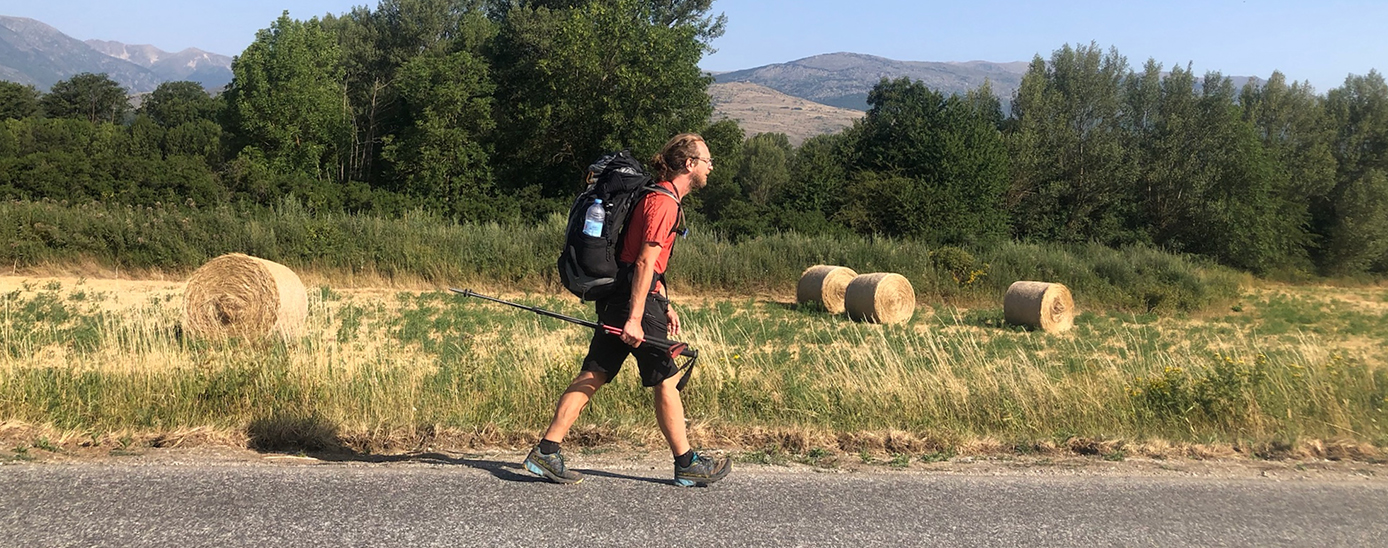
The original article was written by Anna Zaera and published originally in Surtdecasa on 8 February 2023. The copy on this website is my personal archive.
The Italian artist Marco Noris has lived in Barcelona for twenty years. In the summer of 2022 he began a new art project consisting of a journey on foot to carry water from the Ebro delta to the sources of the Segre. He wanted to reflect on time and memory, and to use walking as a tool of artistic research. The project Sequere, produced by the Institut d’Estudis Ilerdencs, adds to a trajectory marked by other projects that take cartography and displacement as a method of discovery. This practice is also the origin of On the Border — 300 km, 25 days, 198 mugas, 212 works (2017) and Border Place-Names (2022), works shown in ‘Un altre fi. La resta. Art i antifranquisme’, the exhibition on view at the Born Centre de Cultura i Memòria. In this case, he addresses subjects such as ecological collapse, through the landscape of a river crossed by the Battle of the Ebro, fires, drought, reservoirs, nuclear plants and intensive farming and livestock.
— Do you need to know a territory in order to walk it?
On the contrary. For me, walking it is a form of knowledge. If it were a better-known territory, I probably wouldn’t walk it. Art is a tool to reveal, to discover. I take a territory that has a meaning for me. Once, a Pakistani artist asked me why I didn’t go walking in Pakistan, and I told him I would need a reason to go there. There is no better or worse place. I can walk through a place where I live or a new place. In a way, I walk as if I were a stranger. I walk to make it mine, to set down roots there. It is a paradox, because roots keep you stuck to the ground, and walking is precisely the opposite. It is to begin an approach to the territory, without having too preconceived an idea.
— Does it have to be a place that inspires in you an impulse of discovery?
Yes. Exactly. The fact that I walk through a place means I have an interest in it. An encounter between the territory and the artist. There is a match.
— One of your projects is a route through the border area of the Pyrenees range. Now you are making a route going up the Ebro river to the Segre. Do these such identifiable geographical “features” inspire you?
Not always. I did a project for which I won a grant at an artists’ residency, and the project consisted of going to the residency on foot. The project always begins with an idea that goes beyond the territory itself. There is a theoretical idea that connects to the territory, but it stands above it. For example, the idea of working on the Pyrenees border was linked to a work on the Republican exile. I was working on the theme of uprooting. I like not to limit myself to intellectual or conceptual work from the studio, but rather to go there and turn it into experience.
— And in the case of Sequere?
What matters is the symbolic gesture. To take the water from the river’s mouth and carry it to the source. To regenerate this cycle of eternal return.
— Does each project link to the next? It seems they are geographically connected?
Perhaps so. But it is a construction I am making as I go. Since I began walking in 2017, everything has been a discovery. I didn’t walk before. And when I started doing it, I saw that I liked it and that it came out well. It is true that when a project ends, new questions or new issues are born. In Sequere this idea of delivering, and delivering oneself, is important. Of delivering the water to the river.
— What does walking as a tool of knowledge mean to you?
To create the circumstances to feel authorised to speak. Not to speak about something out of ignorance. To know from presence. As a tool. Being there and seeing a territory, I can form an opinion and it gives me many references. It lets you join points, events or places more easily because you are visiting them in real time. This opening in time and space gives you a different gaze. If you visit the territory you can speak about everything connected to it. Historical memory, climate emergency. It is like a trigger to generate a theory. Experience gives more value to small things.
— There are now many proposals linking art and walking.
Yes, many times walking in art is rather an end. In my case, it is a tool, a means. As an artist I want to take responsibility for my social role. I want my project to be able to reveal something that is not only for me.
— You don’t identify with walking as an aesthetic practice.
Not entirely. For me it is necessary to go further. The father of this theory is Francesco Careri. There are many people who don’t define themselves as artists and also walk. When I was doing Sequere, in Oliana, I met a young man who was walking from Castelló to Andorra to go and work there. He had no art project. He walked only along the road, he had no gaze upon the territory. And he walked too!
Photo: Celeste Reyna
— You were telling me you are working on a project about walking in the Carmel neighbourhood of Barcelona together with Celeste Reyna and Nora Ancarola?
Yes, walking to generate community and also as a tool to heal. In this case, a tool to get to know the neighbourhood and share it with the group.
— So one of the most interesting aspects of walking is this relational dimension?
Yes. I like to think of walking not as an individual act, but always in a community context. In Sequere there were also moments when I tried to walk in community, with a creative community from Amposta. During the journey I created spaces of encounter to walk together.
— In the case of the exhibition ‘Un altre fi. La resta. Art i antifranquisme’ at the Born Centre de Cultura i Memòria, there is talk of the malaise or trauma of exiles. How do you connect with this idea?
I think we connect in the matter of uprooting. Whether the uprooting is chosen or not, whether it is light and chosen like mine, or hard and traumatic, like that of war exiles. In these two varieties there is something in common. In the case of the peninsula, you cannot travel across Spanish territory without the war being present. Even though it may seem something from a century ago, it is very present. Partly because justice has not been done, partly because many years of dictatorship were lived through. Either way, it is an open subject. I have pulled the thread of this war and, in a way, I have also been discovering myself. Discovering the word exile, the conflict of uprooting.
— What have you discovered?
That both the exile and the uprooted have an unresolved tension between love and hatred towards the adoptive homeland. The impossibility of feeling part of the territory and the longing for your land of origin. For me, walking is a way of healing, of accepting the present. As must happen with the adoption of children. As the psychoanalyst Celeste Reyna, who accompanied me in Sequere, says, it seems that parents have to accept the child, but in reality it is the child who has to accept and adopt the parents. In my case, I think walking is this. A gradual accepting of the territory.