Independentism and democracy
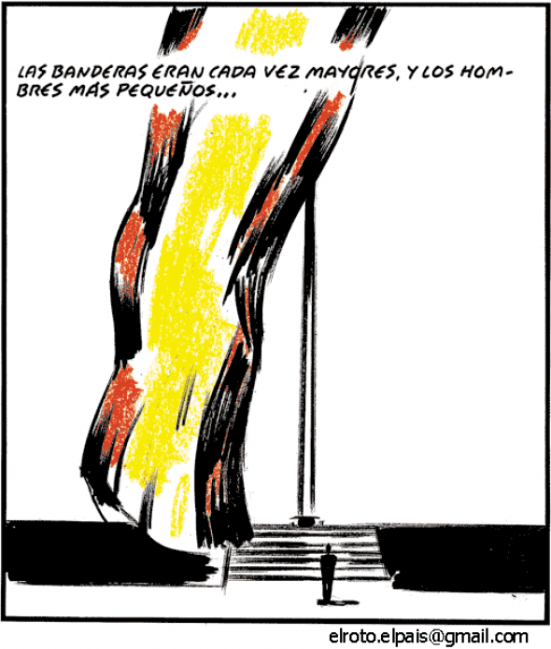
El Día de la Independencia catalana, si llega, será el propio 1 de octubre, o el 2 o, como mucho, el 3. La ley prevé que, si gana el ‘no’ en la consulta se convoquen, de manera inmediata, nuevas elecciones autonómicas. Y si vence el ‘sí’, según ha explicado la diputada anticapitalista Gabriela Serra (la CUP es coautora del texto), la proclamación de la independencia catalana en un plazo máximo de 48 horas desde el escrutinio. 1.
During the summer, the CUP and Junts pel Sí declared that, if they won the referendum, they would proclaim the Catalan Republic in barely two days, regardless of the turnout. A statement that left no one indifferent and that raised a controversial scenario: how should the Spanish State respond to a situation of this kind?
Personally, I believe this stance was what put the central Government between a rock and a hard place, forcing it to act by trying to block the vote2. Waiting until the vote and facing a possible declaration of independence would have created an even more tense and unmanageable climate.
That said, I can’t help reflecting on how things would have changed had the independence movement adopted a more open and dialogue-minded approach. That strategy, so inflexible and removed from certain democratic principles, seems to have closed doors rather than opening them. On top of the unacceptable pro-independence stance, there is also the weight of the questionable value of this referendum and of its result, in which the ‘yes’ barely gained the backing of 37.8% of the electoral roll3. A result clearly conditioned by irregularities, such as the participation of people who voted more than once in favour of the ‘yes’, something I can confirm from direct experience.
What is clear is that the only truly constructive way out for all parties would be a referendum driven and promoted by the Spanish Government itself. Besides being a gesture of great political and democratic value, it would guarantee both the legitimacy of the process and that of the result, closing this divisive chapter once and for all. But, of course, we’re in Spain, a country that, it seems, is incapable of healing wounds.
- El Parlament declarará la independencia de Cataluña si gana el sí( El Periódico, 4 de julio de 2017)
- ¿Es obligatorio formar parte de las mesas del referéndum? (I 23 preguntas más) (El Nacional, 4 de julio de 2017)
-
Xabi Barrena. “El Parlament presenta la ley del referéndum con la mayoría independentista”. El Periódico. Última modificación 4 de julio de 2017. https://www.elperiodico.com/es/politica/20170704/presentacion-ley-referendum-grupos-parlamentarios-6146060. Accedido el 28 de enero de 2025. ⤶
-
There was a heavy intervention by the National Police and the Civil Guard to close polling stations and seize ballot boxes. These actions resulted in clashes and accusations of violence, with images that went around the world. ⤶
-
According to the Catalan government’s data, more than 90% of voters declared in favour of independence, with a turnout of around 43%. However, these results were questioned for the lack of guarantees. Camilo S. Baquero. “# Un 90% de ‘síes’ con 2,2 millones de votos y una participación del 42%, según el Govern”. El País, 2 de octubre de 2017. https://elpais.com/ccaa/2017/10/02/catalunya/1506898063_586836.html. Accedido el martes, 28 de enero de 2025. ⤶