The Siurana: Anatomy of an Extraction
On 27 March the route of my project The Open Shore (La vora oberta) begins. As context, I have synthesised the content of a couple of documented sources, with the aim of bringing this conflict closer to those who are not familiar with it.
The Siurana river is the backbone of the Priorat, so much so that in the territorial reorganisation of the Republic in 1936, it was proposed that the comarca be named “Conca del Siurana”. Yet for almost a century, most of its flow never reaches the sea: a diversion system built in the 1930s redirects its waters towards the Baix Camp (Tarragona). What began as a hydraulic solution has become a territorial conflict that goes far beyond engineering.
The Open Shore (La vora oberta) begins with a journey along the Siurana river, from its source in the Prades Mountains to its confluence with the Ebro. The project addresses the water transfer to Riudecanyes as a territorial and symbolic wound that empties the river’s natural course and turns it into an extracted body. With the support of Terra d’Art / Isabelle Meyer Award 2025.
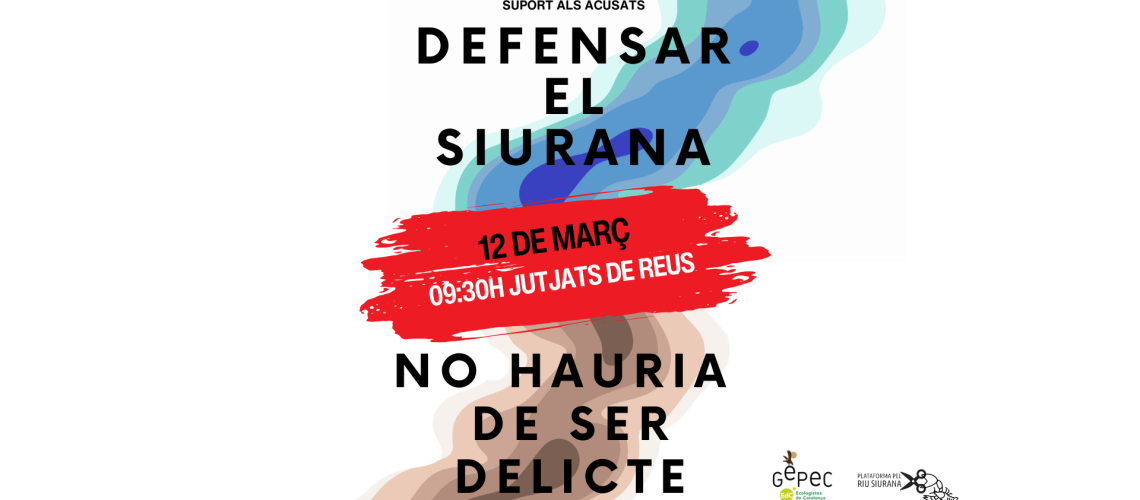
This Thursday, 12 March 2026, two activists from the Plataforma pel Riu Siurana (Siurana River Platform) stand trial at the Reus courts. The charge: unlawful diversion of water. The sentence requested: more than four years in prison and over 7,000 euros in fines. The underlying reason: having returned to the river, for a few hours, the water that has been diverted for decades.
A long-standing problem
It all began with the Riudecanyes reservoir. Built in 1916 in the Baix Camp, it soon proved insufficient to supply agriculture and the towns of the area — particularly Reus. The solution found was to look to the neighbouring basin: the Siurana, a river that rose in another comarca.
In 1926, the Spanish state approved a project to divert water from the Siurana to Riudecanyes via a 21-kilometre canal and a 9-kilometre tunnel cutting through the sierra that separates the two basins. Work began in 1935. In 1971, the Siurana dam was built to reinforce the system. The result is an interconnected hydraulic system that still operates exactly the same way today: water from the Priorat travels to the Baix Camp.
How much water is actually diverted?
The figures speak for themselves. In a recent measurement at the diversion point, the river was flowing at 304 litres per second. Of that volume, 244 litres — roughly four-fifths — were being diverted out of the basin. Only 60 litres continued along the Siurana’s natural course. At times, barely 10% of the water stays in the river.
The original concession justified the diversion by referring to “surplus water”. But can a river have surplus water if it dries up every summer? Many experts and environmental groups have spent years questioning that definition.
A river in decline
The ecological consequences are visible. The reduction in flow has caused the disappearance of pools and small natural reservoirs that were essential for wildlife. Invasive vegetation has colonised the riverbed. Seasonal floods — necessary to renew the ecosystem — no longer occur with the required frequency. And the Siurana, which historically never dried up completely, now does so regularly every summer.
The minimum ecological flow set by the Agència Catalana de l’Aigua (Catalan Water Agency) is just 20 litres per second — a figure that contrasts sharply with the 200 l/s provided for in the original concession, and which many consider wholly insufficient to keep the river alive.
The trial: who is prosecuting whom
In 2017, around fifty people carried out a symbolic action at the Siurana dam: for a few hours, they returned to the river the water that the diversion system extracts from it every day. It was a peaceful protest. Years later, two of its spokespeople — Andreu Escolà and Anaïs Estrems, from GEPEC-EdC and the Plataforma pel Riu Siurana — are being tried for it.
Those prosecuting them are the Comunitat de Regants del Embassament de Riudecanyes (the private body that manages the public water diverted from the Siurana). The formal charge is unlawful water diversion. The paradox is hard to ignore.
One of the accused describes the situation bluntly: “Justice spends hours prosecuting us while year after year a cross-basin diversion continues that goes against the European Union’s Water Framework Directive.” He adds: “Those who profit from an essential public good tell us we need to be generous. And they say it while drying out our comarca, leaving us without the little water we have, and filling their pockets doing so.”
The trial, which should have been held in June 2023, has accumulated four postponements over three years. It will finally take place on Thursday 12 March 2026 at 9:30 am at the Reus courts. The Plataforma pel Riu Siurana is calling for public support outside the courthouse.
More information in the GEPEC article: El riu Siurana a judici.
The underlying question: water justice?
The Siurana conflict is not merely technical. It is also political and territorial. The Priorat is a comarca with scarce resources and limited institutional influence. The Camp de Tarragona, with greater demographic and economic weight, has historically been able to secure access to a resource that, nonetheless, originates in someone else’s territory.
These kinds of imbalances between river basins are at the centre of the European debate on water governance. Increasingly, water management models prioritise the ecological sustainability of rivers, respect genuine minimum environmental flows, and balance the needs of different territories. The EU’s Water Framework Directive, in fact, establishes clear obligations in this regard — and numerous voices point out that the Siurana diversion systematically breaches them.
Is there a solution?
Yes, or at least there are serious alternatives on the table. Technical studies point to the reuse of treated wastewater — especially from the Reus sewage treatment plant — as the most viable route to reducing dependence on the diversion. It is estimated that water reclamation could provide between 4 and 6 cubic hectometres per year for irrigation, a volume equivalent to or greater than what is currently extracted from the Siurana. To this should be added improvements in irrigation efficiency and better use of other sources already available in the Camp de Tarragona.
The Siurana conflict is, ultimately, the result of decisions taken almost a century ago that now collide with a new reality: climate change is worsening water scarcity, and what once may have seemed a reasonable exchange between territories now demands an honest reassessment. Until that reassessment arrives, two activists stand before a judge for having done, for a few hours, what nature has been demanding for decades: letting the river flow.
Sources
- Comissió de Comunicació Prioritat. “Siurana, quan el riu sona.” Butlletí Prioritat, nº 2 (Estiu 2025). ISSN 3081-7137 (printed ed.); 3081-7145 (online ed.). https://www.are.na/block/42708928.
- Molero, Núria. “El Riu Siurana a judici: El judici de defensa del riu Siurana arriba després de quatre ajornaments i tres anys de retard.” GEPEC-EdC. 5 March 2026. https://gepec.cat/el-riu-siurana-a-judici-el-judici-de-defensa-del-riu-siurana-arriba-despres-de-quatre-ajornaments-i-tres-anys-de-retard/.