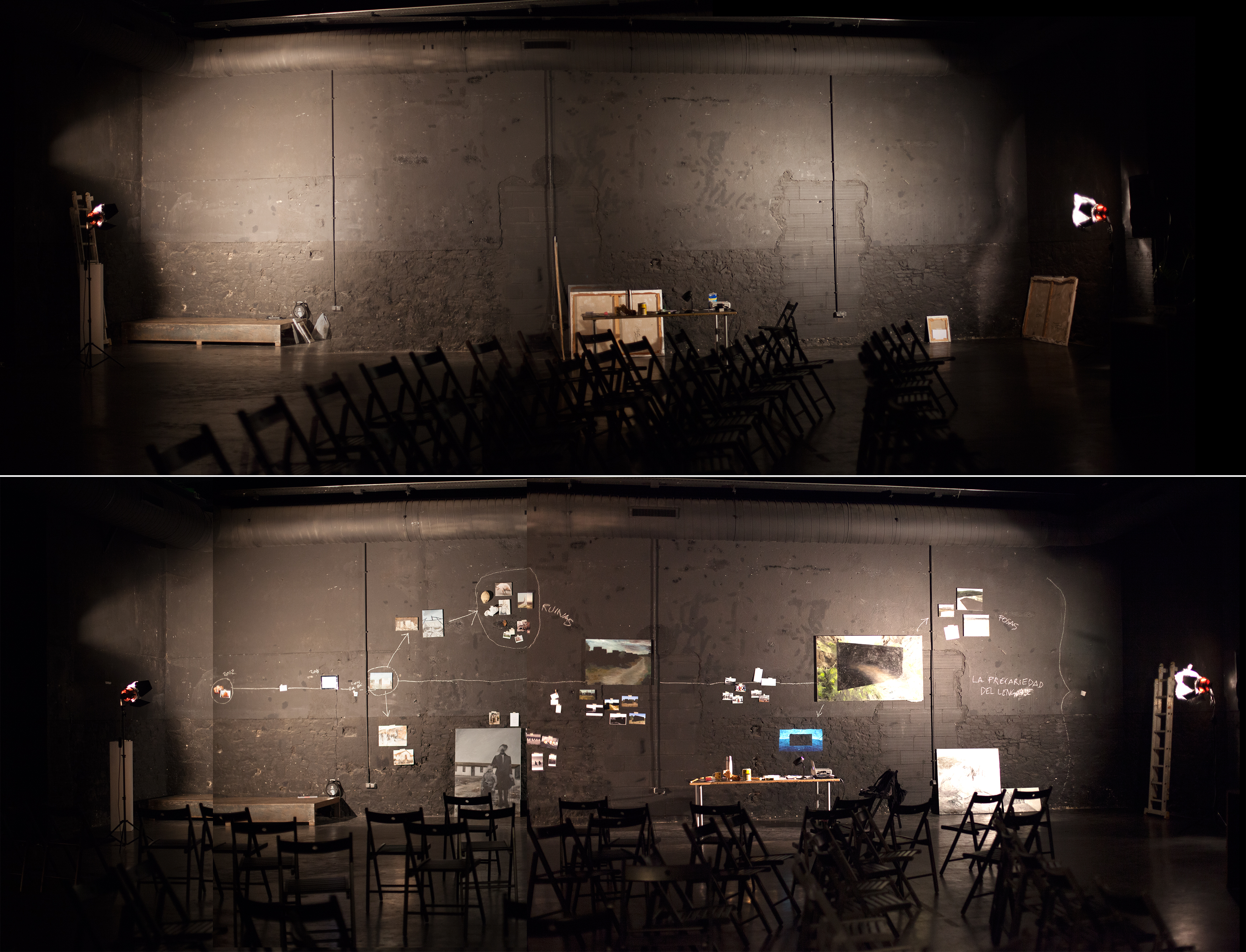
Paratext #7
2015
In November 2015, at Hangar Barcelona, Marco Noris presented a performative action linked to his painting project in progress, centred on the notions of exile, uprooting, historical memory and contemporary migration policies. During the presentation he constructed a live mind map on the wall, articulated through videos, photographs, objects, paintings and texts, connected by arrows and annotations, thus translating a hypertextual organisation system into physical space. The action, lasting about 40 minutes, was received very positively and culminated in the exhibition of a 15-metre-long mural composed of 52 pieces.
11 November 2015. A performative presentation at Hangar, an art production centre in Barcelona. Photos by Marzia Matarese.
My presentation at Hangar focused on making visible the creative development of my work on exile and uprooting, historical memory and contemporary migration policies.
Since it is a painting project in progress, it was clear to me from the start that it would not be the classic slide show commented on by the artist: Hangar is a place where the digital image is the norm, and for that very reason I considered it necessary to emphasise the singular material presence of painting, without losing sight of key values such as experimentation, research, sharing and open-source practice. I therefore opted for a performative format that met my communication needs while also allowing me to create something I could consider an artwork in itself.
My Paratext consisted of creating a live mind map along one of the walls of the Ricsson hall. A map that would explain the origins of the project, the references, the discoveries, the mistakes and the choices I had to make during its development. The use of different elements and languages (video, photo slideshow, objects, paintings, drawings, photographs, notes, letters, photocopies), connected to each other by arrows and texts written on the wall, allowed me to translate a hypertextual content organisation system into physical space. The presentation lasted about 40 minutes, was very well received and achieved all the goals set. The final work, a 15-metre-long mural made up of 52 pieces, remained on display to the public.