Macchina automatica / no anima1
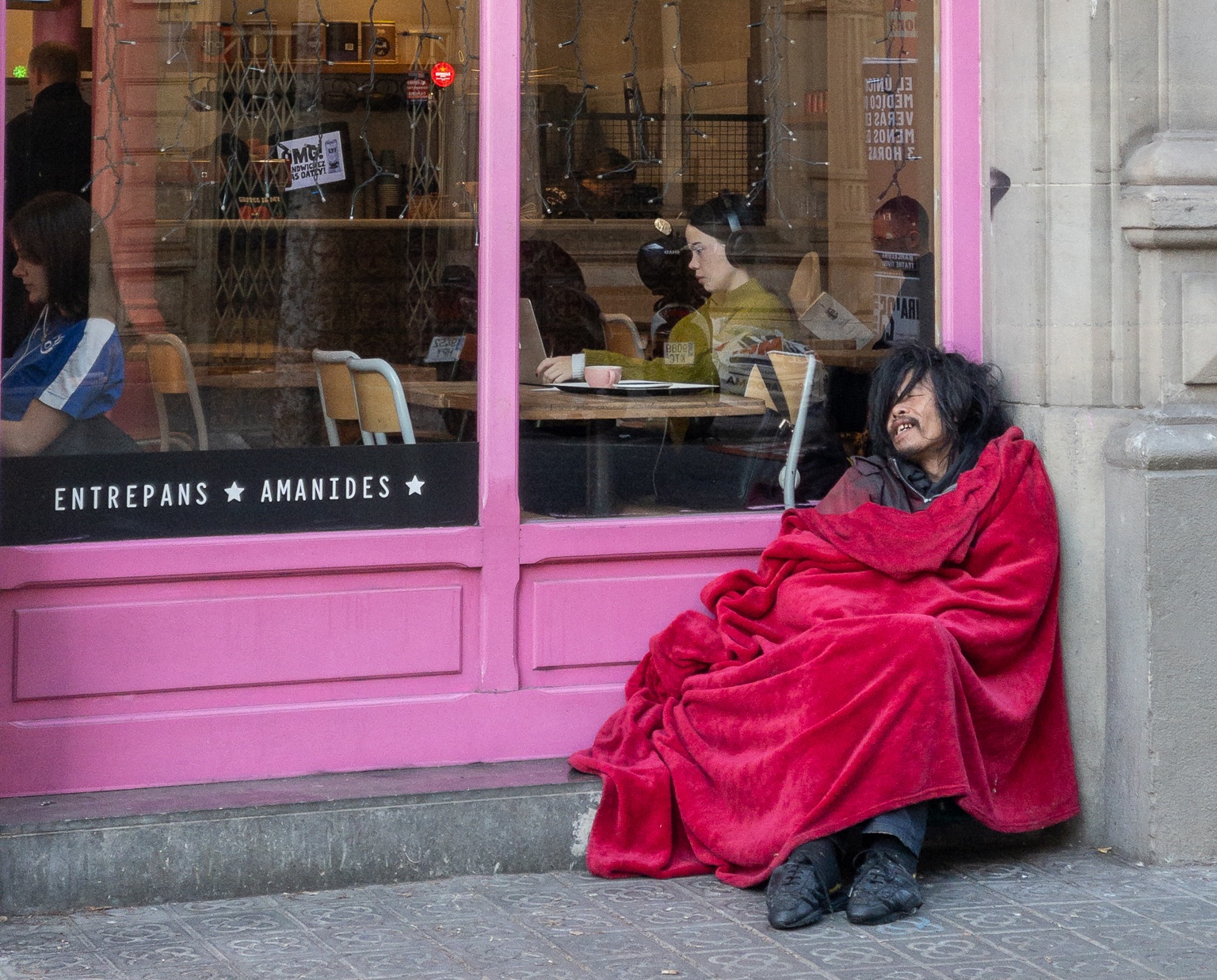
Barcelona, January 12, 2025. I apologize for any possible lack of respect toward the people portrayed. I have not found another way to sustain the point of this article without publishing the image. If anyone recognizes themselves in it and would like me to remove it, they can contact me.
A man with Asian features sleeps sitting on the doorstep of a shop window. His expression is tense, pained — it’s not clear he’s still alive. On the other side of the glass, a young woman sits at a table in a café, headphones on, absorbed in her laptop. It’s not obvious who got there first, but what is clear is that the man’s presence doesn’t seem to register with her at all.
I remember arriving in Barcelona over twenty years ago, how surprised I was by the indifference of passers-by towards the conditions of the homeless. Coming from the wealthy provinces of northern Italy, I wasn’t used to this. It was rare to find people lying on the ground, something still considered a matter of gravity. Twenty years later, the number of homeless people has grown considerably, and with it the piercing ache I feel at the systemic indifference towards this discarded and abandoned humanity. An indifference I adapted to, feeding it, as in the case of the photograph that opens these lines. Like everyone else, I’m so accustomed to these scenes that my interest in this man’s condition has been limited to this photograph and these words. Whether he was alive or dead, suffering or sleeping, it was someone else’s business.
This image looks like a staging of the new contemporary Zeitgeist. Separated by a thin pane of glass, on one side the technologized comfort of integrated humanity, on the other the others, the leftovers. The fact itself is not new — what makes the difference is what remains unseen. Or what is taken for granted.
The questions that arise are many, but the most urgent is this: who is supposed to be the other one in charge of resolving the emergency of a human life?
The girl with headphones in the café is us, facing the suffering of others. The shop window is the screen2 — a surface that shields and projects, a barrier that turns an emergency into a spectacle and the spectator into an innocent bystander. The distance between an exhausted man sleeping on a doorstep and a genocide broadcast live is merely a matter of scale: the mechanism is the same, and we keep waiting for someone else to act. Neutrality, in the light of injustice, sides with the oppressor,3 but so does waiting. Waiting for someone else to take charge is already a form of complicity.
Indifference towards the homeless is not individual cruelty — it is systemic automatism.4 So absorbed in our cycle — produce/consume/be entertained/die —, we seem like machines that have stopped registering the other as human. Super comunicati, super connessi, zero emozioni, zero coscienza.5 The device has become an instrument of our own submission,6 and with it our capacity to see the other has been reduced to the gesture of photographing them, commenting, and moving on.7
-
The phrase “macchina automatica no anima” appears in the song A Tratti by CSI (Consorzio Suonatori Indipendenti), from their 1997 album Tabula Rasa Elettrificata. ⤶
-
Franco Battiato in Shock in My Town (1998) observed human behaviour like an entomologist: “Stiamo diventando come degli insetti, simili agli insetti” (We are becoming like insects, similar to insects). Luciano Bianciardi proposed in La vita agra that “la rivoluzione deve cominciare in interiore homine” (the revolution must begin within), renouncing the mechanisms that automate us. ⤶
-
See Il dispositivo come strumento di sottomissione: “We have become human extensions of the machines we invented.” ⤶
-
See Assenti: “È assente l’umanità del dispositivo” (The humanity of the device is absent). ⤶